Fish Care 101

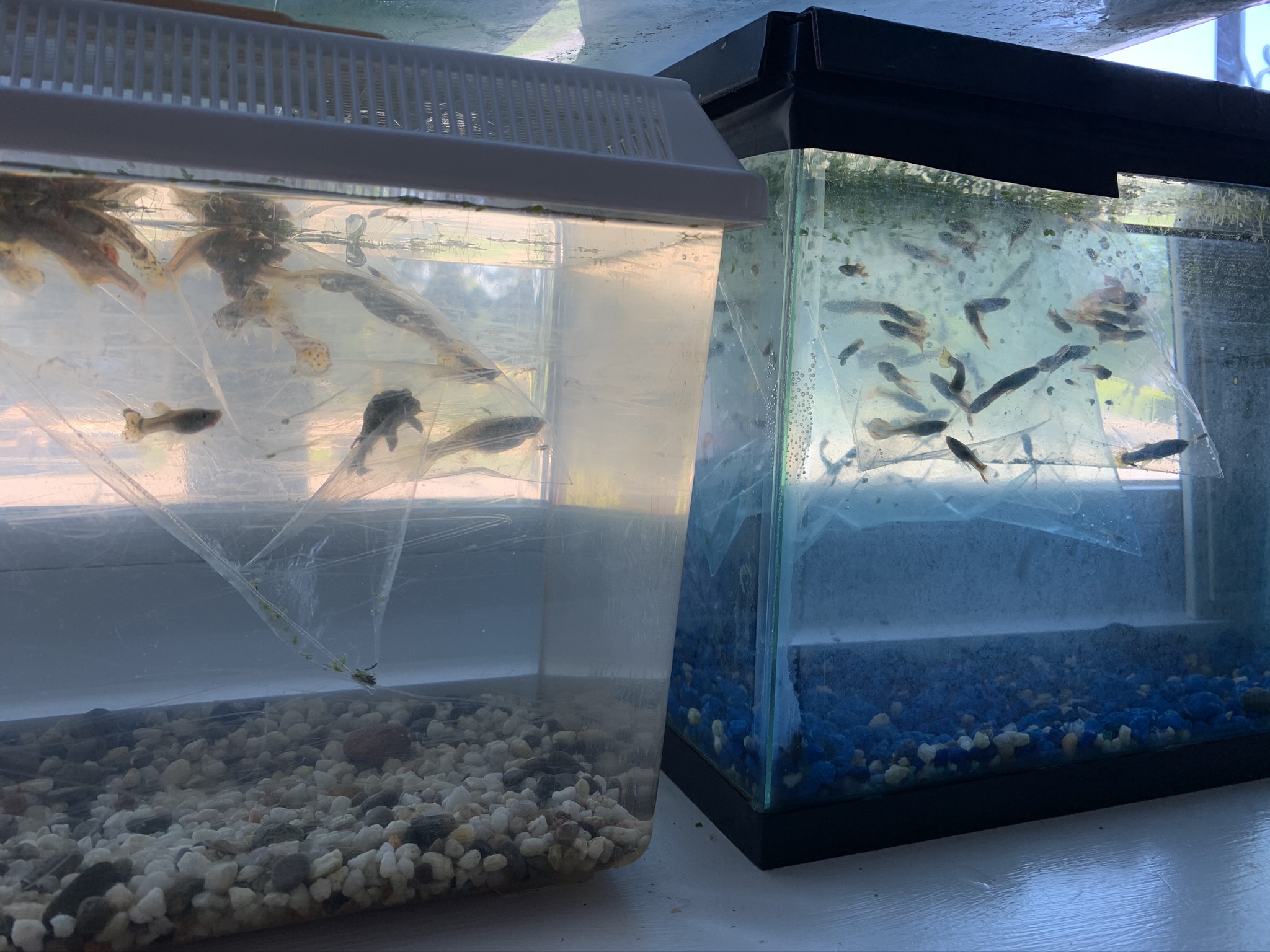
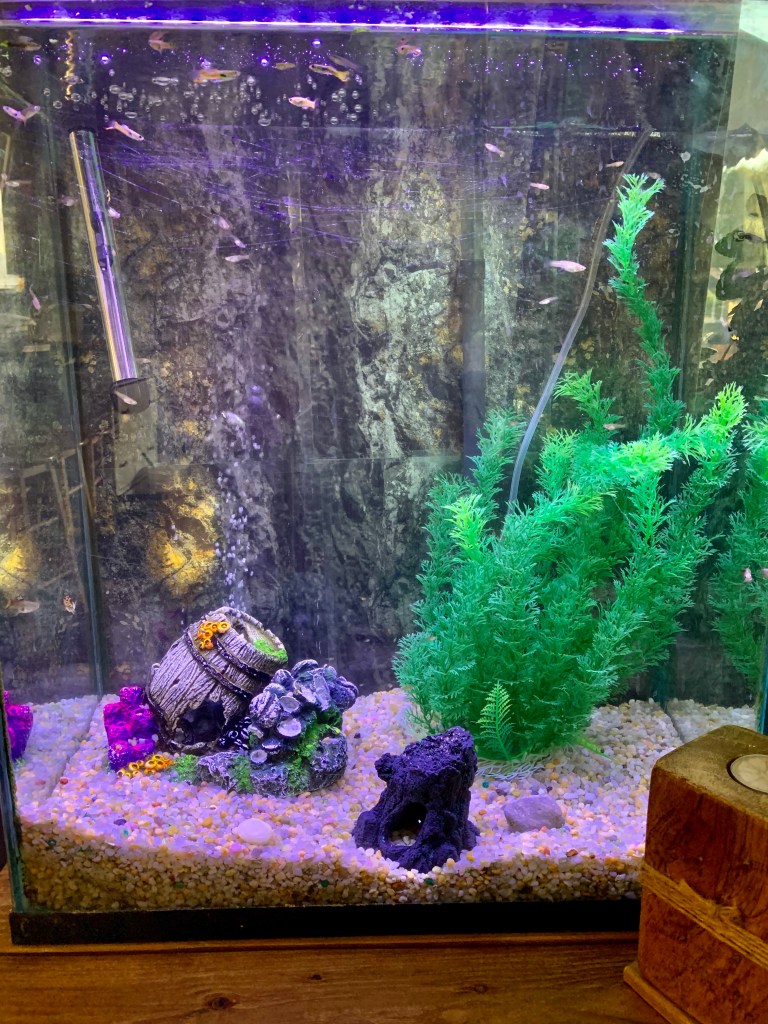
We accomplished a big task this week… we cleaned the fish tank. Aquarium enthusiasts be warned, I have had fish for years and know that tanks need regular maintenance… but I am not the person to follow if you need good fish advice on how to clean an aquarium. But, let’s back up a bit shall we? We have a tall tank that sits in our living room — I’d say it’s about 35 gallons or so. We’ve had it for years and have done goldfish, tropical community fish and slightly more aggressive ones. My brother kept cichlids for years, but I am too “frugal” for that hobby favourite. Which brings me back to this week. A few years back we picked up some cheap show guppies — an easy-to-care-for community fish that is pretty enough to look at. Check out my facebook page if you wanna see the video of our fancy guppies! Fun fact about show guppies is that they are also live bearers (which means they breed well and have live babies). So, needless to say, our stock grew from 6 fish to about 80. Yes, 80. We also had some living duckweed and some other live aquatic plant in there… and an aggressive green algae that soon took over. ( I told you I wasn’t someone you should take advice from). Alas, here we are in the tail end of a global pandemic with nowhere else to go, so we decided to take the beast on!

You see, cleaning a green monster is no easy task when you still have about 80 fish… many of which are teeny tiny babies. You can’t just dump and pour. Fish tanks have delicate balances of good bacteria and things that fish need — not to mention our city water has a lot of bad chemicals that fish don’t need! And so we began the task of categorizing fish and separating them out to other balanced tanks. We even saved the littlest one which is about the size of “l” with eyeballs. We “traded in” quite a few to our local pet store (which was an ordeal in itself — self distancing with our bucket after sloshing the original container around in the car. Sorry about the seats, darling.) We knew we might lose a few to stress. Overall, though… a fairly successful fish move after their small tank “vacation” as the youngest referred to it as.

The tank itself wasn’t too hard to scrub out… and years of thrifting and pet ownership provided a nice selection of accessories to choose from, but we needed a new background. Did I mention I am “frugal”? Which means I wasn’t about to pay for a new fancy piece of glossy paper when I could print, laminate and creatively tape together my own… let’s just call it crafty, okay? So… after a week or so of scrubbing, fishing, waiting and bucket patrol… Volia! Happy fish and a clean tank!

The “After”

The week long task had me musing about fish, of course. And there are lots of examples of fish references in the Bible: the fishers of men miracle, Jonah and the giant fish, five loaves and two fish etc. Margaret Feinburg’s “Taste and See” book has some good thoughts on the “fishy” parts of scripture, so I encourage you to see my review about that here. However, my internet travels took me to another fish that I found interesting to read about: The Jesus Fish or ichthys. I’m sure you’ve seen it on jewellery, bookmarks or the back of someone’s bumper.

What I didn’t know was that the ancient Greek symbol was an acrostic of ΙΧΘΥΣ (ichthys), which translates into ‘Jesus Christ, Son of God, [Our] Saviour’.

Iota (i) is the first letter of Iēsous (Ἰησοῦς), Greek for “Jesus”.

Chi (ch) is the first letter of Christos (Χριστός), Greek for “anointed” (of the Lord).

Theta (th) is the first letter of Theou (Θεοῦ), Greek for “God’s”, the genitive case of Θεóς, Theos, Greek for “God”.

Upsilon (y) is the first letter of (h)yios (Yἱός), Greek for “Son”.

Sigma (s) is the first letter of sōtēr (Σωτήρ), Greek for “Saviour”.

Pretty cool, eh?

Apparently the symbol was used by the early church as a “secret” symbol during the Roman persecution of early Christians. It helped to identify whether a stranger was a fellow follower or an enemy. As the story goes, the greeter would draw the first half of the fish, and a friend would complete the reciprocal line if they understood the initial drawer’s reference. If not, the stranger would just appear to be drawing arches in the sand. The symbol was also spotted on secret meeting places or worship gatherings. It made a comeback in the 1960’s as Christians began to use it as a “logo” for Christian merchandising. Do you have it somewhere?

I hope you liked that little tidbit of information on such a simple idea. In these strange times of identities and isolations, I’m reminded that I too, have conversations to start about my identity as a “fisher of men (and women)”. That I belong to a bigger world of people who follow Christ, and that by doing so I may be persecuted for my own beliefs. Like our aquarium, I can get overcrowded, choked out and clouded up without regular maintenance. And it can be a big job to clean it up and get our lives back to looking sparkling again.

So, next time you see an ichthys on the back of someone’s car, send me off an email to remind me to change my fish tank’s filters okay? Be blessed, my friends!

Be Like a Bee: Make Dandelion Honey!

May 20th was World Bee Day! A day to acknowledge these tiny pollinators and the important job they do for us. I think it is so fascinating that these tiny creatures were created with a unique and vital job for (literally) the world’s food supplies, and yet we still place so little value in them. In fact, we often think of bees as annoying and squash-worthy. Did you know that they can fly at speeds of about 15 mph? Or that it takes 556 worker bees to gather a pound of honey, each individual producing only 0.8 grams in her entire lifetime?  It takes one colony of honey bees (around 30,000 bees) to pollinate an acre of fruit trees (from our Canadian stats). I bring them to your attention to highlight another forgotten piece of nature: the humble dandelion.

Taken from the French phrase: “dent de lion” describing the tooth-like spikes on the flower’s leaves, these “weeds” have one of the longest flowering seasons around. Every part of the plant can be used: leaves, root and flower for edible delights! And — they are one of the first sources of foods for our ever-more-valuable pollinators! Again, a unique example of God’s intricate designs for our planet! This week, we learned to appreciate this symbiotic balance of God’s goodness even more – by trying our hand at Dandelion Honey!

I’ve been studying more about “natural” uses of things, and watching videos on foraging and gardening (still trying to be a bit “greener”) and use less, and thus discovered dandelion honey. I suppose it is technically dandelion syrup — but it tastes more like flowery honey of bee pollen than the mapley goodness Canadians are famous for. You can find lots of videos and articles on How to’s, each with their own quirks, tips and tricks, but I thought I would lay it out here for y’all on how we did ours. Check out my Pinterest Boards for more ideas. Note this was our first attempt, so proceed with caution!

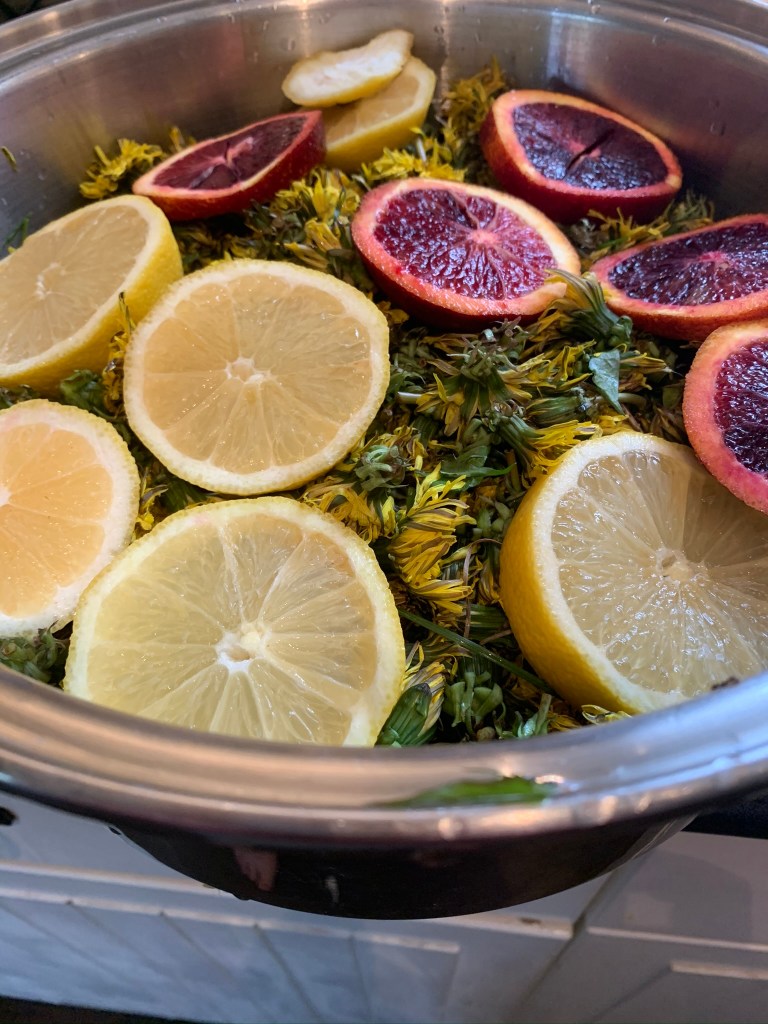
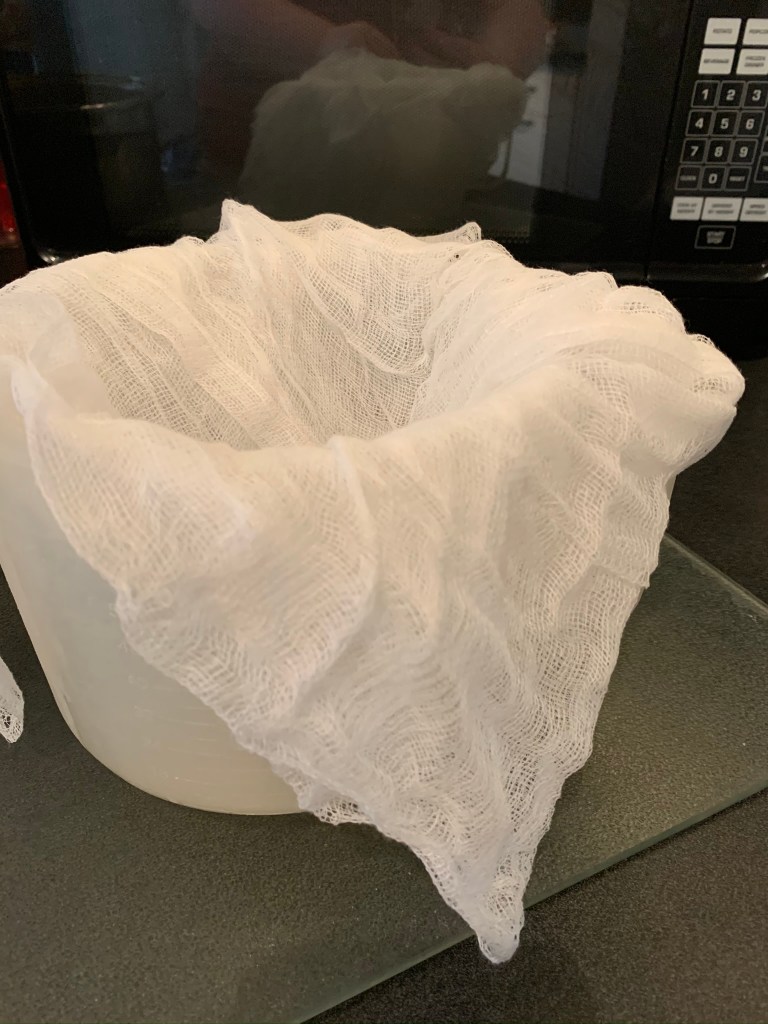
It’s kind of an old fashioned recipe, so measurements were not all that precise, which is just up my alley ‘cuz I love to “wing it” a lot in the kitchen. First, the hubby picked a bucket full of dandelion flower heads (from our very own lawn — which we knew was pesticide free and abundant). I rinsed them off and picked out some grass (and the odd ant). You can leave the green head on the flower, and although we left some stems on (because I am lazy) I learned after that the stems are fairly bitter so should be removed. Some videos made tiny batches of a few cups of flowers, but we had a lot! You then make a dandelion “tea” by covering the flowers with water and boiling all the goodness out of them (about a 10 minute boil). We added a sliced lemon and a sliced orange to season even more (as per the videos). The tea is then cooled and steeped overnight in the pot. The next day, I strained all the “juice” out with cheesecloth — about 10 cups worth of liquid from my “big batch”.

The next part may be disheartening to the health conscious of you looking for natural recipes, but you add a lot of sugar to the mix here. Most how to’s say even amounts to your liquid, some say a little less, so for my 10 cups of tea, I added 8 cups of white sugar — okay a little less than 8 cups because I added a bit of brown sugar because I didn’t want to be left with no sugar left in the house! You get my point, though, right? It’s a lot of sugar! The next step is the syrup part of boiling off. And as any good Canadian knows, syrup takes a lot of effort to boil down. Did I mention I am not patient? I boiled my mixture for about an hour — just until it started to thicken up around the sides and slide between my fingers like the viscous syrup we know and love. I should have boiled it longer. Perhaps a lot longer. I was hoping it would thicken up upon cooling, but it didn’t. Our final product was pretty runny — but oh so yummy!

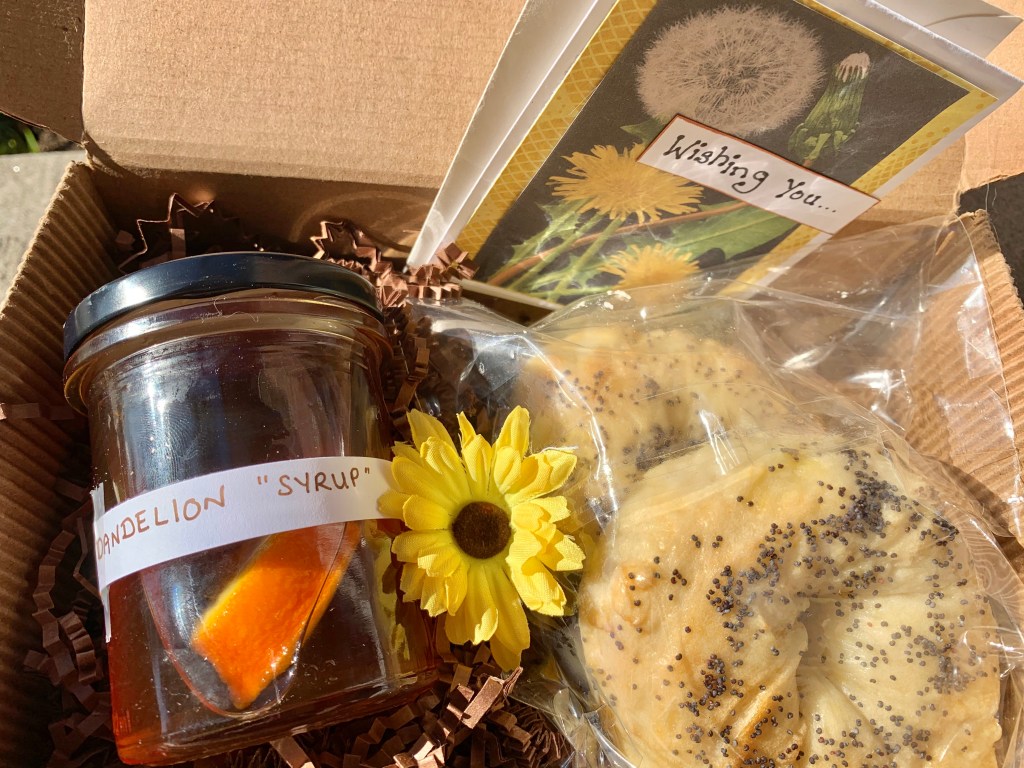
I think we got about 5 or 6 jars of the honey packaged up in the end. I gave two of them away as gifts. The citrusy sweetness is apparently a very good elixir for sore throats and such — not to mention great on pancakes! Or spoonfuls at a time. 🙂

A Sweet gift for a Special Person!

So there ya have it: Dandelion Honey! As I reflected on these two simple beings, honeybees and dandelions, I couldn’t help but muse how deep their examples are to us. Both are seemingly insignificant. Common place in our springtime worlds. Easily ignored and often thought of as nuisances to be got rid of. Yet so vital to our earth’s mission. Much like we often feel in our own worlds. I recently put these words on our letterboard at home: You are sons and daughters of the King. Act like it.

I want my kids (and me) to be reminded that we are children who belong to the Most High (Psalm 45) So often we feel insignificant. Worthless and commonplace with little to offer to a bigger world at large. How can we serve when we are so small? Or so common place that no one pays any attention to us? Especially when things can be air brushed and photoshopped. The scriptures remind us of our place. We are heirs to the throne and will one day sit next to the Creator of the world! He who delights in the honey bee and humble dandelion, finds absolute sweetness in the sight of us! Rejoice in this my beloveds! And be reminded of it next time a bee buzzes by, or you see that field of “weeds”.

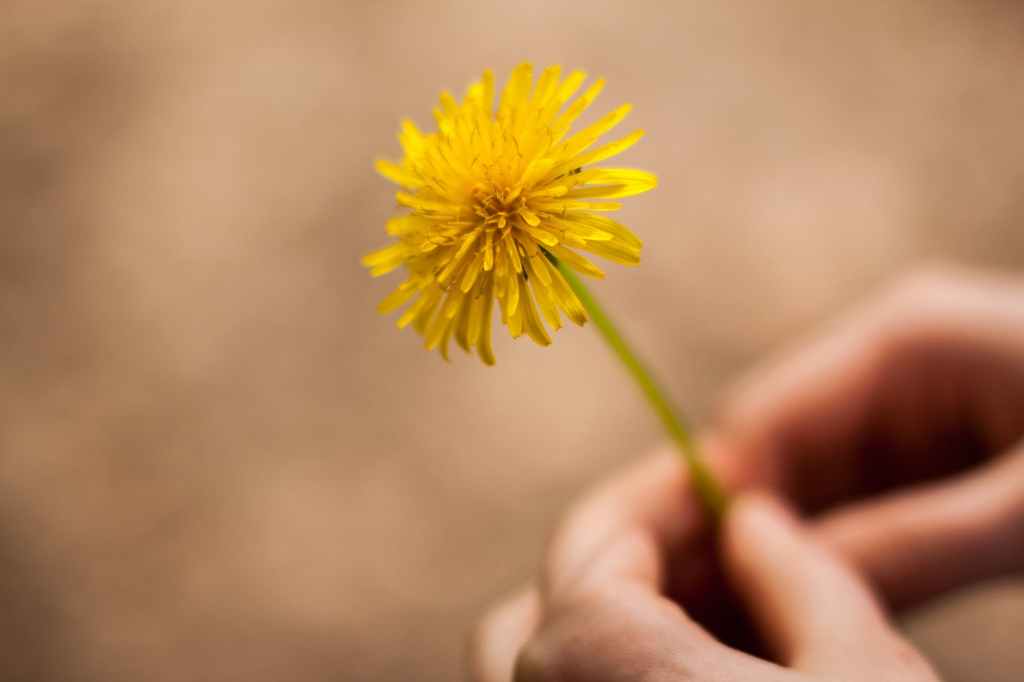
Photo by John-Mark Smith on Pexels.com

Investigate Chromatography

Well… day whatever of self isolation. I’m missing routine. I’m unmotivated and finding it difficult to find things to blog about. They’ve just announced that school won’t be back in session until at least May 31st. Pray for us mommas. In light of all this, I thought I would repost this article I wrote for a fellow blogger looking for some science ideas. It’s not been posted on my site, so – perhaps it would be a fun project you could do during isolation? God’s creation is vast and colourful, and hopefully spring will bring me some new ideas to muse about, but until then, enjoy this one! Stay safe, friends.


Greetings!  I am so pleased to share some thoughts with RedHeaded Patti as a guest blogger!  As a scientist and mom of four (plus the extra odd neighbourhood kids and students that sometimes visit) it was a no brainer for me to answer her call for a SUMMER OF STEM ideas!  We are always learning and love to share with others! So let’s get right down to it:  Let’s investigate Chromatography!  We originally tackled this project for this year’s science fair and it is a perfect investigation for all sorts of children or students… you can tailor it to any age by investigating just a bit deeper or a little less.  We wanted something easy, fun and colourful to learn about!  To read about our finished project, check out the link here.  We post every Tuesday and would love to have you join our adventure over at mittonmusings.com!

ChromatographyChromatography, in its simplest terms, means “separating parts of a mixture”.  Scientists do this for all kinds of mixtures:  gases, liquids and solids can all be separated into their various parts.  For example, blood can be separated out to search for specific diseases.  Oil companies often use chromatography to weed out impurities in their products. Gases can be diffused and distilled to investigate all about bombs and warfare.  Distillation is closely related to chromatography and is another method for separating mixtures.  Perhaps you can investigate the differences!  For our example, we are going to be using paper chromatography to separate liquid pigments (in markers) into their various colours.  Pigments are also found in other everyday objects like leaves and candy… even more to investigate!

So… let’s gather our materials:

paper cups

coffee filters

markers (various colours and types)

rubbing alcohol

elastic bands

a dropper

a coin

water

Once you have all your materials now is when the fun starts!!  Here’s the basic method and what our results were.  Feel free to try all sorts of markers and colours and see what results you get!

We took 6 cups and wrapped one coffee filter on the top of each cup and secured it with an elastic band

We picked 5 sharpie colours and traced the coin to make a circle on the filter

We dropped a few drops of alcohol inside the ink circles and watched the circle as it “grew” and separated by moving along the filter paper

We did the same with the Crayola marker, except we used water instead of alcohol (you’ll see why later)

Our Results:

colours

The ink separated (spread) and some turned into different colours along the coffee filter.

Green…. showed yellow

Dark Blue…. showed a light then darker blue

Purple…. showed pink and violet

Teal…. showed yellow and blue-green

Black (Sharpie)…. showed purple

Black (Crayola)…. showed blue and pink

Our favourites were teal and purple!!

Wasn’t that fun?!  Now, as good scientists, we have to ask the question: WHY?  Markers have ink — that’s what makes the colours.  Ink is a mixture of a fast-drying liquid and pigments (the substances that give something colour).  Sharpie markers have alcohol-based ink (permanent), and Crayola markers have water-based ink (not permanent).  So, when we added more liquid (alcohol or water), the ink spread out and separated into other colours.  Did you notice that black is really a mixture of a whole bunch of colours?!

We also observed that some colours spread out further than others.  The water based marker spread the most. This is because “solutes” (the things that make up a mixture) will move along depending on how much of the solute there is in the mixture.   Water based inks have a lot of “solvent”(the stuff that solutes are mixed into)…which is why they are not permanent and are easily washable. Some inks showed more than one colour even though they started out looking like only one!  This shows us that inks (or pigments) are really made up of a mixture (or solution) of different colours that produce the various shades of “single” marker colours.  Isn’t science great?!

We hope you enjoyed this fun and easy science experiment.  Remember it next time you are enjoying some colouring this summer with your markers — and don’t ever stop learning!leaves