Investigate Chromatography

Well… day whatever of self isolation. I’m missing routine. I’m unmotivated and finding it difficult to find things to blog about. They’ve just announced that school won’t be back in session until at least May 31st. Pray for us mommas. In light of all this, I thought I would repost this article I wrote for a fellow blogger looking for some science ideas. It’s not been posted on my site, so – perhaps it would be a fun project you could do during isolation? God’s creation is vast and colourful, and hopefully spring will bring me some new ideas to muse about, but until then, enjoy this one! Stay safe, friends.


Greetings!  I am so pleased to share some thoughts with RedHeaded Patti as a guest blogger!  As a scientist and mom of four (plus the extra odd neighbourhood kids and students that sometimes visit) it was a no brainer for me to answer her call for a SUMMER OF STEM ideas!  We are always learning and love to share with others! So let’s get right down to it:  Let’s investigate Chromatography!  We originally tackled this project for this year’s science fair and it is a perfect investigation for all sorts of children or students… you can tailor it to any age by investigating just a bit deeper or a little less.  We wanted something easy, fun and colourful to learn about!  To read about our finished project, check out the link here.  We post every Tuesday and would love to have you join our adventure over at mittonmusings.com!

ChromatographyChromatography, in its simplest terms, means “separating parts of a mixture”.  Scientists do this for all kinds of mixtures:  gases, liquids and solids can all be separated into their various parts.  For example, blood can be separated out to search for specific diseases.  Oil companies often use chromatography to weed out impurities in their products. Gases can be diffused and distilled to investigate all about bombs and warfare.  Distillation is closely related to chromatography and is another method for separating mixtures.  Perhaps you can investigate the differences!  For our example, we are going to be using paper chromatography to separate liquid pigments (in markers) into their various colours.  Pigments are also found in other everyday objects like leaves and candy… even more to investigate!

So… let’s gather our materials:

paper cups

coffee filters

markers (various colours and types)

rubbing alcohol

elastic bands

a dropper

a coin

water

Once you have all your materials now is when the fun starts!!  Here’s the basic method and what our results were.  Feel free to try all sorts of markers and colours and see what results you get!

We took 6 cups and wrapped one coffee filter on the top of each cup and secured it with an elastic band

We picked 5 sharpie colours and traced the coin to make a circle on the filter

We dropped a few drops of alcohol inside the ink circles and watched the circle as it “grew” and separated by moving along the filter paper

We did the same with the Crayola marker, except we used water instead of alcohol (you’ll see why later)

Our Results:

colours

The ink separated (spread) and some turned into different colours along the coffee filter.

Green…. showed yellow

Dark Blue…. showed a light then darker blue

Purple…. showed pink and violet

Teal…. showed yellow and blue-green

Black (Sharpie)…. showed purple

Black (Crayola)…. showed blue and pink

Our favourites were teal and purple!!

Wasn’t that fun?!  Now, as good scientists, we have to ask the question: WHY?  Markers have ink — that’s what makes the colours.  Ink is a mixture of a fast-drying liquid and pigments (the substances that give something colour).  Sharpie markers have alcohol-based ink (permanent), and Crayola markers have water-based ink (not permanent).  So, when we added more liquid (alcohol or water), the ink spread out and separated into other colours.  Did you notice that black is really a mixture of a whole bunch of colours?!

We also observed that some colours spread out further than others.  The water based marker spread the most. This is because “solutes” (the things that make up a mixture) will move along depending on how much of the solute there is in the mixture.   Water based inks have a lot of “solvent”(the stuff that solutes are mixed into)…which is why they are not permanent and are easily washable. Some inks showed more than one colour even though they started out looking like only one!  This shows us that inks (or pigments) are really made up of a mixture (or solution) of different colours that produce the various shades of “single” marker colours.  Isn’t science great?!

We hope you enjoyed this fun and easy science experiment.  Remember it next time you are enjoying some colouring this summer with your markers — and don’t ever stop learning!leaves

A Season of Growth

Back when school was actually in, and I was musing about if homework was actually necessary, (Ha! Little did I know!) there was a lot of talk about this idea of “growth mindset” among educators and how it influences our students and how they learn. I suppose, it really is how we all learn. In case you have no idea what I am talking about, here is the general idea:

growth mindset, proposed by Stanford professor Carol Dweck in her book Mindset, describes people who believe that their success depends on time and effort. People with a growth mindset feel their skills and intelligence can be improved with effort and persistence. They embrace challenges, persist through obstacles, learn from criticism and seek out inspiration in others’ success.

Those who hold a growth mindset believe that they can get better at something by dedication of time, effort and energy. Working on one’s flaws, and the process—not the outcome—are the  most important components. With time and practice, people with a growth mindset believe they can achieve what they want. The opposite of a growth mindset is a fixed mindset.

From: https://tophat.com/glossary/g/growth-mindset/

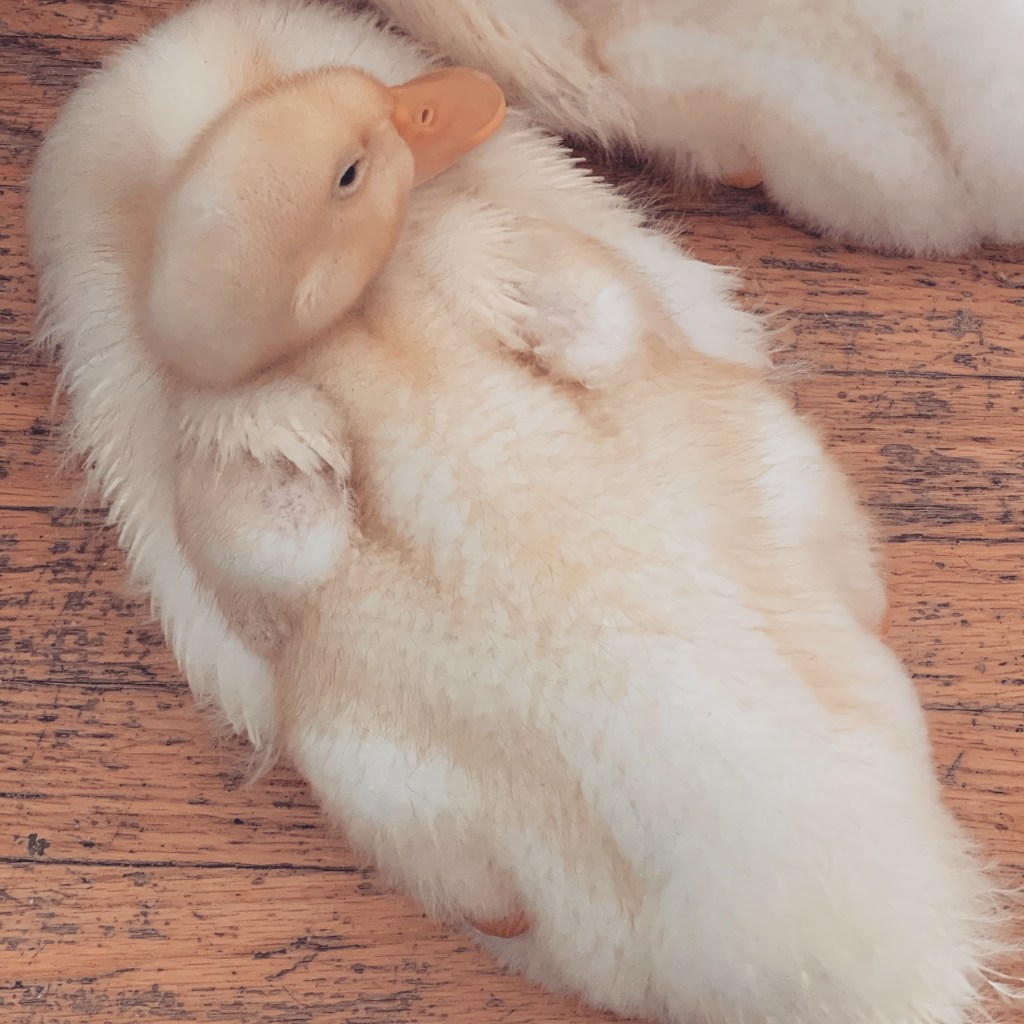
There is some confuddled methodologies and thought processes surrounding this whole idea — but it is what I have been musing about this week. “Growth”. I’ve been thinking about literal growth — changes you can physically see, as well as the more mystical, unseen growth, that we all do as people when faced with situations like this global pandemic we are all experiencing right now. Three weeks in, and people are starting to talk about the consequences. I’m curious to see how this will change us. Will it change us for the better? Or will we revolt and protest? Only time will tell. Speaking of time; it is finally starting to be “spring-like” around here and, like I have said so many times before, time has a way of moving forward… worldwide pandemic or not. The buds are starting to show up on the trees. We have started our little seeds and the kids have cleaned up the backyard garden (hurray for quarantine — we are ahead this year!) and we are dreaming about fresh veggies! We also fostered some baby ducklings for 3 weeks — which was definitely a growth project! Those tiny things grew fast! I’m not sure I am cut out for farming — as much as this city girl dreams about it, (constantly) it would certainly take some “growing” on my part. Perhaps these cuties will be a topic for a future muse.

Which brings me back to my muse. I think growth is a unique entity. We have “growth spurts” and we have long, slow, lengthy times of maturing that seemingly takes forever. It’s hard to see growth in those times. We think that nothing new is happening. Like a young tween waiting to get curves or the first facial hair. Often, those are times of renewal and recovery (or perhaps discovery?) — so that all the conditions are right for good growth. It’s been a month of ups and downs for the Mitton crew during lockdown 2020. I get excited about a new project or homeschool, and just as quickly get sad and frustrated. Some days I dream big, and other days I can’t seem to get moving at all. They tell me that’s normal. It seems we are in a season of growth.

So as I navigate this time, I’ve been encouraged by the words of Lamentations 3. Verses 22 and 23 are the most famous, of course, and the most uplifting when it comes to sparking Hope and Encouragement:

But it is interesting to note that the full chapter is a lament. It’s not that encouraging. It’s full of despair and depression. Then the writer comes to the realization of God’s ancient idea of a growth mindset. Each morning is a new day. And God’s love is faithful. It’s a process, with ebbs and flows of good and bad. A journey with a goal, where success is measured by time, effort and persistence. And failure is part of the process.

So, what about you all? Are you feeling stuck in the lament? Are you wallowing in the darkness of unemployment, uncertainty or just simple boredom? Tomorrow is a new day. Filled with new doses of mercy, light and hope from a God whose faithfulness is timeless. May you be encouraged, my friend, by the journey itself. Your successes will be achieved through time, effort and tiny steps forward. Oh… I am certainly not there either. My mind dreams big, but the flesh is weak, and laziness, to be truthful, is a whole lot easier. Share me some love, okay? Post a thought, some encouragement, or something you’re doing to make this season of “slow growth” helpful for all of us! I love to hear your comments.


Want some ideas for some things to do during your “slow growth” time at home? Check out these posts: How to Stay Motivated Brag Tags DinoSaurs or browse through my old muses like the Colouring Party!


Meaning of Gold and Silver

Happy St. Patrick’s Day. Despite all the unprecedented things going on in the world right now, what, with lock downs, quarantines and virus watching, time still has a way of ticking on. And today happens to land on St. Patrick’s day (March 17th)… so you think I’d be doing some musing about Green, but I’ve changed my mind and have decided to focus on the pot of Gold at the end of the rainbow… and its metallic friend, hi ho Silver. I think we will save Green for next week. So, for all of you who are practicing social distancing and catching up on blog posts… welcome to the colouring party!

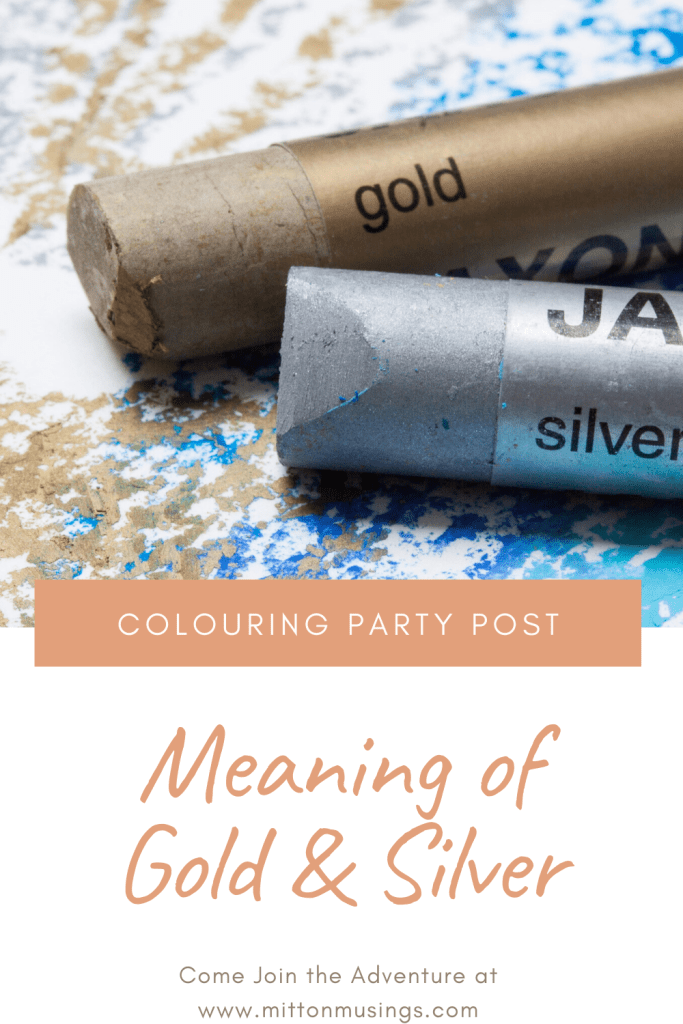
When I was younger, gold, silver, copper and all the other metallic colours came in a separate, “deluxe” crayon box… so you knew they were something special. All shiny and sparkly. Gold and Silver are no less special today. I decided to lump them together in our study, but there are some significant differences between the two colours. In some ways they are on opposite ends of the colour spectrum… gold on the “warm”, fiery yellow side and silver on the “cool” blue or grey, moonlit end of the colour wheel. Nonetheless, we are going to consider them together and under the general idea of precious metals.

Often associated with money, gold and silver “meanings” generally follow those connotations: wealth, flashy, proud, expensive. Reserved for the rich and used for choice occasions and events. Gold is often linked with Heaven and the “riches” that await us. Silver is a bit more “common”, although no less precious. Silver in more modern times is often associated with technology and the idea of sterile, mechanical worlds (and often the fear associated with that). Both precious metals are ancient forms of money. Silver was usually stamped with images, whereas gold was melted into shapes. In the King James version of the Bible, gold is mentioned 417 times, silver 320 times, and “money” 140 times. Obviously, God has a lot to say about these precious colours.

Let’s start with Gold. First mentioned in Genesis, gold is mentioned “in the land” as it’s elemental form. Exodus and much of the Old Testament goes on to describe the melting down of gold jewelry for golden idols, the ark of the covenant, the temple, the golden calf, the golden arches… oh, no, wait, that’s something completely different. The value in gold as an element seems to be in the fact that it can withstand purification and the process of “going through the fire”. It’s the pure, end product that is most valued. The perfection, if you will. It’s Heaven for believers. The final goal at the end. It’s what God originally intended for us.

Silver, on the other hand, is a little more “commonplace”. It’s the currency that was used in day to day transactions. Both Joseph and Jesus were “bought” with pieces of silver. Could we say that it represents our earthly lives? I read that there is no mention of silver in the Bible’s description of Heaven. I haven’t checked out that fact, so let me know in the comments if you know otherwise. Silver is said to be the redemptive colour of Truth. It’s how we are “bought” here on earth and all our natural tendencies. Once we acknowledge the truth that Jesus has redeemed us on the cross, we’ve been stamped as His. Like the emperor’s stamp in ancient forms of money. He becomes our ruler until we reach the golden gates. Then we become the one He designed for us from the very beginning.

Now, we have to remember that these are all “interpretive”, and the colours really have no magic formula or redemptive properties themselves. The prophet Haggai reminds us that all the silver and gold belongs to the Lord (Haggai 2:8), as does all the the things we hold precious in this world. It’s just interesting to muse about and see what connections we can make. Like this Fun Fact: an average 70 kg person’s blood contains 0.2mg of gold floating around in it. Apparently, it is beneficial for our joint health; and because it is a good conductor of electricity, gold helps our neurons fire — making for good brain connections. Silver, however, is not used by the body at all and is eliminated. Too much silver can actually be dangerous and with long term exposure to the element, turn your skin a blue-grey colour.

So. As the world ponders the developments currently unfolding in the COVID-19 pandemic, and we watch the stock markets fall, and many of us worry about health and our jobs as we reduce our social interactions and cancel large gatherings, I hope you are reminded that like gold, we are being refined for the other side. When our common, silver-lined comforts like toilet paper are being hoarded, it becomes toxic to us. Our minds should be focused on what we were made for before sin entered our world. That we look forward to the streets of gold and not simply on the exchange of silver pieces here on Earth. We have a Hope, beloveds, not simply a “silver lining” in uncertain times, but a true, solid, refined by fire, Hope in Christ. So stay Golden, my friends.


I’m excited to be hosting this colouring party here at mittonmusings.com! I can’t wait until we pull out the next colour from our box of crayons next week! Don’t want to miss the adventure?! Join us and receive the muses each week via email! Subscribe here.