Welcome to the party! We’re going to start off by opening up our box of crayons and just taking a moment to appreciate the entire rainbow!! I was excited to see this National Geographic photographer’s photo on my Instagram feed this week:

Photo by Keith Ladzinski @ladzinski | A fleeting beam of sunlight draws out a prismatic rainbow on a stormy day in Grindelwald, Switzerland. This rainbow lasted mere minutes, dominating the landscape among a scene of dramatic storm clouds that shrouded the tall peaks of the valley. To see more photos of the #Alps please visit @ladzinski. (Full credits given as above!)
A fleeting glimpse of God’s majesty at work! Isn’t it beautiful?! Now, there’s a whole lotta science that goes along with rainbows, but let’s just look at the simplified version, shall we? Basically, you need some water droplets still hanging around in the air… and then some light from the sun. Then scientists include a whole bunch of things like reflection, dispersion and refraction. If you are interested, you can check out this link from the Smithsonian. The arc, or curve you observe is because you can only see a rainbow from your specific spot relative to the distance from the light source and a whole bunch of other mathematical stuff. That’s why we sometimes see a double rainbow or circular rainbows can be see from airplanes. And the colours? Traditionally, we say that the rainbow contains red, orange, yellow, green, blue, indigo and violet. But technically, the rainbow is a continuous spectrum of colours — the human eye can only see a few. Rainbows are sooo much more than we perceive! And I say perceive because rainbows are really optical illusions — you can’t reach out and touch one, and there really is no “end” point. Sorry, no pot of gold, either. Just a fascinating blip that shows up in our world every now and then. Especially if you happen to be in just in the right spot at the just the right time!
Perhaps this illusion is why we are so drawn to them, and why rainbows have come to mean so much more to us than simply science in the sky. We’ve associated the arcs with God’s promise (we’ll get to that), ancient writings in various aboriginal folklore and chinese writings associate it with creation and new beginnings, and rainbows have often been paired with bridges and the idea of “crossing over” to better places. We know they are something special. Something spiritual. More recently, rainbows have been adopted with peace, love and freedom. Often in our own attempts to make ourselves more “in tune” with the divine, we assign rainbows more “magical properties” than their original meaning intended.
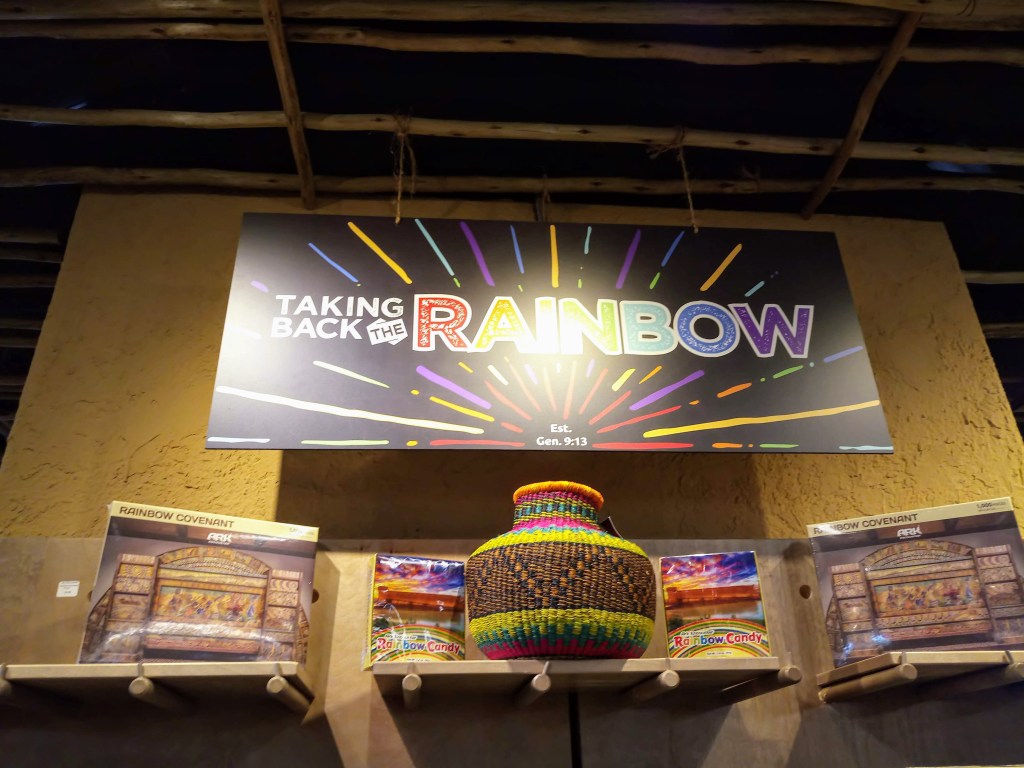
When we visited Kentucky’s Ark Encounter back in 2018, I was intrigued with their merchandise advertising the idea of “taking back the rainbow”. At first I wondered: take it back? Doesn’t it belong to everyone? Obviously referencing the LGBT+ community’s use of the rainbow in it’s Pride flag, this campaign is drawing attention to the differences between the Biblical account of God’s rainbow and the Pride’s adoption of it. We live in a city that hosts one of the largest Gay Pride Parades every year. Many of our public schools and community centres display the rainbow flag. It’s a common sight in our neck of the woods. Digging a little deeper for this post, I did discover that the original Pride Rainbow Flag contained 8 colours, but now is represented by only 6; a fact many conservative Christians are quick to point out in their defence against the homosexual lifestyle as a perversion of the original rainbow. It is important for us to take a stand on Biblical Truths in our society — but even more important to do it accurately and not simply copy and paste or “like” posts without investigating first. Answers in Genesis does make a good point in reminding us that “…Before you accept the claims on social media, take care to consider whether they are accurate, and then indicate your approval or share them with others. ” The science states a rainbow is a spectrum, remember? It’s not 6 colours or even 8. I encourage you to investigate more at Answers in Genesis and other Bible believing sites to make our arguments consistent with both the Bible and science as we engage in conversations with the LGBT+ community and their allies.
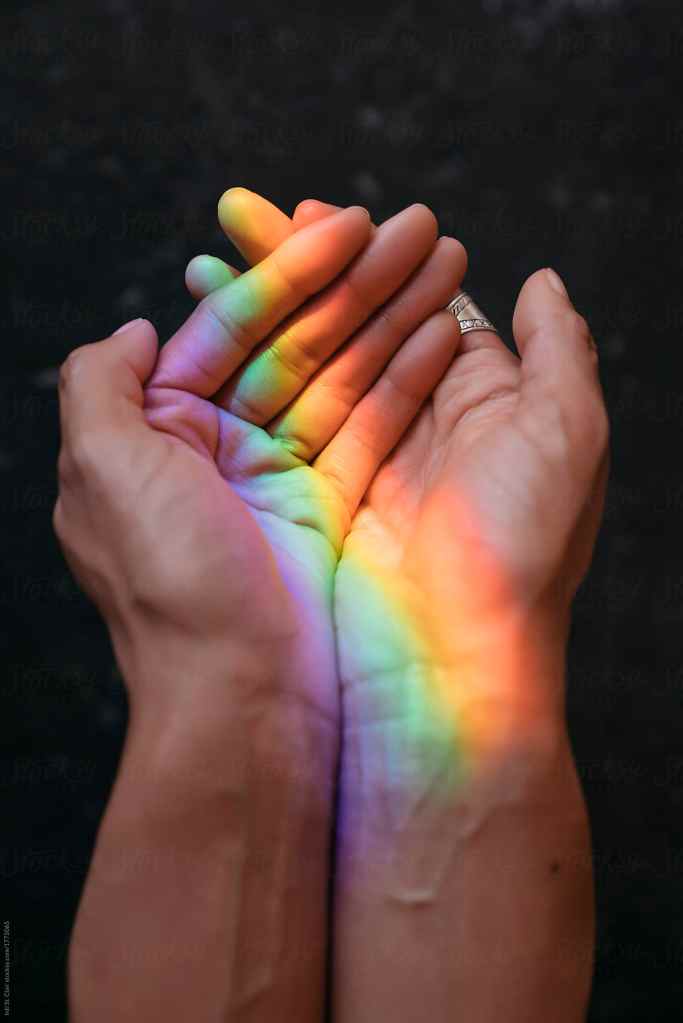
So let’s delve into the Biblical accounts of the rainbow! Rainbows are mentioned in three books: in Genesis, and then again in Ezekiel and Revelation. The later accounts use them in description of brilliance and specific colours, so we may touch on those later in our colouring party. Genesis 9 is our description of the very first rainbow and it’s promise for Noah — and for us. The flood is over, Noah has built his altar, made his sacrifices, and once again inherited the land, and God says this:
” 21 The Lord smelled the pleasing aroma and said in his heart: “Never again will I curse the ground because of humans, even though every inclination of the human heart is evil from childhood. And never again will I destroy all living creatures, as I have done.22 “As long as the earth endures, seedtime and harvest, cold and heat, summer and winter, day and night
will never cease….…8 Then God said to Noah and to his sons with him: 9 “I now establish my covenant with you and with your descendants after you 10 and with every living creature that was with you—the birds, the livestock and all the wild animals, all those that came out of the ark with you—every living creature on earth. 11 I establish my covenant with you: Never again will all life be destroyed by the waters of a flood; never again will there be a flood to destroy the earth.”
12 And God said, “This is the sign of the covenant I am making between me and you and every living creature with you, a covenant for all generations to come: 13 I have set my rainbow in the clouds, and it will be the sign of the covenant between me and the earth. 14 Whenever I bring clouds over the earth and the rainbow appears in the clouds, 15 I will remember my covenant between me and you and all living creatures of every kind. Never again will the waters become a flood to destroy all life. 16 Whenever the rainbow appears in the clouds, I will see it and remember the everlasting covenant between God and all living creatures of every kind on the earth.”
17 So God said to Noah, “This is the sign of the covenant I have established between me and all life on the earth.” GENESIS 8,9: verses as listed.
So there you have it. The scientific wonder of the rainbow is so delicately placed in our world, when all the conditions are right, to remind us that God is still in control. That even though our human hearts are “every inclination of evil”, He still loves us. Rainbows, like the one Ladzinski captured on the Alps, are reminders to us that God has the power to destroy, but His grace and mercy are abundantly more than we deserve.
I’m excited to be hosting this colouring party here at mittonmusings.com! I can’t wait until we pull out the next colour from our box of crayons next week! Don’t want to miss the adventure?! Join us and receive the muses each week via email! Subscribe here.




 mittonmusings