What Makes a Good Teacher?

There has been much going on in my neck of the woods with regards to education recently. Teachers strikes, contract negotiations, optimum class sizes, budget cuts. It is all becoming a little cumbersome. We are parents in a somewhat unique situation, in that we have grown (well, almost grown) children and one still in elementary school. So we have a broad base of comparison. Youth is a whole other entity and we should have a prayer list a mile long for these blessed creatures. Then a double prayer list for their mommas and dads. Oh no, parenting is not for the weak. Or the squeamish. Especially if you have been blessed with boys, or an over dramatic girl. Or a partner who cannot handle barf. But, I digress. I’ve been working on a baby gift that I have to send off to some new parents soon, and pondered about how differently their little one will grow up — even compared to my youngest. The world changes so rapidly and we must do our best to keep up.

I’m not here to debate the pros and cons of one particular type of education. It’s not my place… although I would love to sit down with you and discuss home schooling vs. private school vs. public school vs… well, let’s just say I would love to sit with you. I have my own views and opinions that may differ from yours. Which is okay because I am not raising your kid. For the record, I am not an educational expert, either. I’ve seen a few systems, though. And most, if not all, of them are broken. There is not a “perfect” way to raise a child — because there are no perfect parents, and no perfect children. Oh, and here is a big revelation… there are no perfect teachers, either. Or class sizes, or budgets, or salary caps, or… you get the picture.

Which is why I always say that you must be involved in your student’s education. It is vital you know what goes on in the classroom and in the system. And in the heart of your student. But let’s back up a bit and think about that: “education”. What does it mean? The short answer is this: Education is the process of facilitating learning, or the acquisition of knowledge, skills, values, beliefs, and habits. (Wikipedia — which may not be your choice for “educational” definitions, but serves my purposes here, so let’s all move on, shall we?) The acquisition of knowledge. You can get that from sticking your finger in a light socket. No system necessary there. But “facilitating learning”? Much deeper thoughts. How does one do this for such a diverse generation? Can we do it for our own kids? For ourselves?

What about those values and beliefs? Who is responsible for those? The high priest? Pastor? Youth specialist? YouTube? We were teasing our church’s youth pastor, recently, that because he wasn’t a skilled ice skater and didn’t know how to play the guitar, that somehow he didn’t have all the necessary “qualifications” of youth leader. (It’s not true, of course!) but what should our teachers possess in order to make them “good” and “qualified” teachers? Four years of seminary? Greek study? Summer mission experience? Married? Single? Oh, we fiercely debate such things. And so I muse: What does make a good teacher?

I think it is someone who cares about the student. Dare I say loves the student so deeply that they want to see them succeed in that “acquisition of knowledge”… so that it changes their lives forever. Someone who can foster a lifelong love of learning. My favourite teachers were the ones who inspired me. Frankly, I hardly remember a thing they taught. I remember the comments or the encouragement, or the way they made concepts come alive or applicable to me and my measly existence in the universe. People who may have thought differently than I, and challenged my way. In turn, solidifying my core values and/or correcting my habits. So, you see, it is all of us. Formal education is only one part of the puzzle. It’s people who challenge the norms, it’s intergenerational mentorship, it’s cross cultural experiences, it’s formal learning in traditional sessions and it’s being creative and using the gifts God gives us. I don’t care if you have your own kids or not, when you come in contact with mine, you are teaching them. Whether you like it or not.

And we fail. Often. But failure, too, is part of learning. Overcoming the failure and the ability to move forward shapes the next mistake, and the mistake after that. So, be encouraged, my friend, that there is only one perfect teacher who walked the Earth. Yet Jesus also grew in “…wisdom and stature, and in favour with God and man…” (Luke 2). He was taught, and was the Teacher. His goals were clear, but loved the students so much that no one was denied the learning experience. Learned men, women, children and outcasts and sinners sat at His feet and were taught with patience and love. Sure, we have our preferences. We have our strategies and pedagogies and they too, ebb and flow as our society changes and the next generation leads the way for a new one. But we should never stop learning. And teaching.

His Eye is on the Sparrow

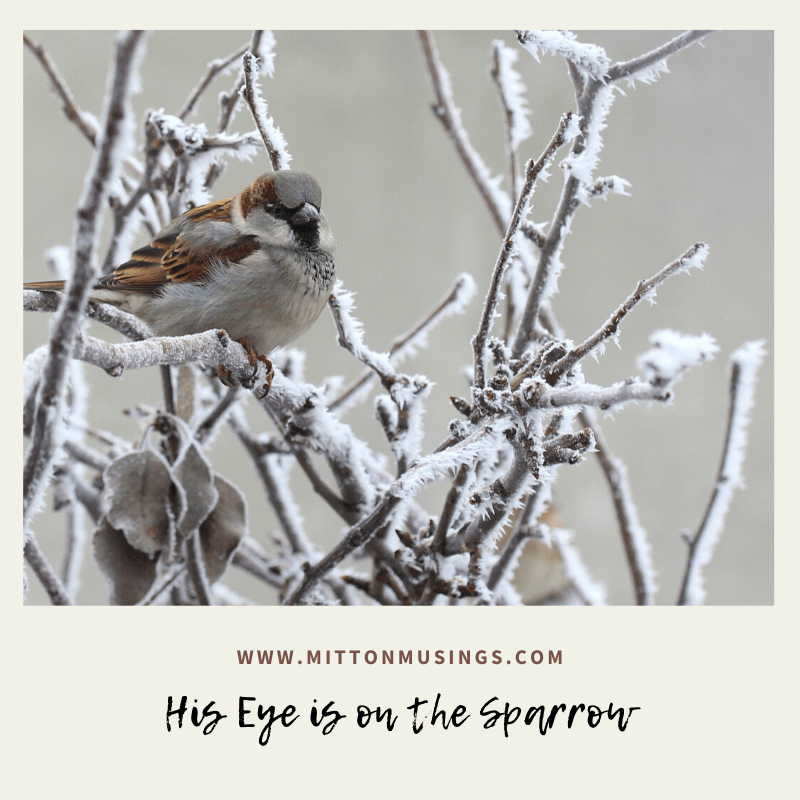
Last week, if you’ve been following along, I posted about using up my leftovers. My Instagram feed shared how I made some little treats for our backyard friends. It turned out to be great timing, because shortly thereafter, we had a wackload of snow dumped on us! I’m sure the birds and the squirrels have tucked themselves away and hunkered down in their hidey-holes to wait out this extreme freeze and snow. Which got us a-musing: How do those teeny little birdies survive this cold? They seem so petite and frail.

Turns out, birds are a little like us humans. Some prefer to give up entirely on winter and fly to the tropics. Let’s just say, those migrating types don’t count. A few of us who can’t afford the time and effort of flying south, choose to batten down the hatches and hibernate for a few days in this extreme cold. Technically, with wildlife, it is called torpor and involves a period of “slowing down” in order to conserve energy. Much like some of us who choose to stay inside and drink hot chocolate on snowy days. I love it when I see evidence of God’s handiwork in nature! It’s all so interconnected and perfectly orchestrated!

This was brought home to me, again, a few weeks ago (before the snow) when I happened upon a tiny clutch of wing feathers. Putting aside the gruesomeness of this tiny winged creature’s demise (discovery and education has a dark side), let’s focus on the science for a minute. Feathers are uniquely designed like tiny, little zippers. If you observe one under a microscope, miniature little barbs link together to keep the fibres tightly attached.

A bird preens and fluffs up to keep the zippers zipped… enabling air to be trapped underneath the layers. The tight barrier allows for flight as the wind gets pushed down, and helps the bird stay warm in extreme weather! Fat build up and specialized body feathers help too… literally the birds wear a down jacket! The piece of wing I found was so small. Perhaps a sparrow? It’s feathers were layered so tightly and knit together so well, I marvelled at the intricate design. Tiny. Perfect.

And so, I am encouraged, again, by the promise in God’s word, that if He takes care of the tiniest sparrow, how much more are we loved? They were uniquely created to survive the harshest winters, knit together and infused with warmth by God’s own breath. As are we. May you be encouraged of that fact, my friends, as am I. Until next week — stay warm!


My backyard goodies were made with leftover gingerbread house pieces and pine cones (from a winter centerpiece) spread with some nut butter and dipped in bird seed! You can also use coconut oil or lard for the “sticky” part if you need a nut free option! It’s a fun Sunday School craft if you need an object lesson on how God cares for us!!

First Fruits vs. Leftovers

I wanted this post to be about first fruits. I wanted it to tell you how I have practiced setting aside time in this new year to make God and my spiritual journey a priority. I wanted to brag about how I resolved to pray and study and claim God’s promises. I wanted to tell you all about what methods I had for keeping on track and share with you all the muses and insights I’ve had since the beginning of January. However, I must admit, that the more I thought about it, the more this post is going to be about Leftovers.

My apologies from the get go if you were looking for inspiration. I was hoping to give it to you — I really was! But if your house is anything like mine, you will understand, because we have been living on leftovers for the last few weeks. I have not done a proper grocery shop for eons! It was only yesterday that our refrigerator was once again filled with “fresh” bounty. The kids have survived on scrounging whatever they could find. I have lived on cheese and crackers and fancy red pepper jelly — hosting my own wine and cheese parties (minus the wine) at every lunch. Only I was the solitary guest to the festivities because I happen to like goat cheese and my family does not. The eldest Mitton went back to University to get balanced meals again. At least her Starbucks has fruit smoothies. So much for home cooking. I did discover turkey soup can be repurposed at least 3 different ways. Yup, leftovers it is.

I giggle when I get coffee at church now. Inevitably someone has brought in that leftover tin of cookies to share because they are trying to clear out the goodies in their own homes. Youth group prizes become repurposed chocolates because, well, kids and teens will eat anything sweet. My backyard squirrels are gonna love our old (and now slightly stale) gingerbread house. We are sometimes a little too blessed aren’t we? We celebrated the holidays with Joy and abandon and are now trying to clear out. We attempt to share and not be wasteful. We recycle and repurpose and be good stewards of the wealth. But it’s still leftovers.

Image by Mark Gilder from Pixabay

So, as much as I would like this post to be about first fruits, it’s really about my own leftovers. Because no matter what your understanding of Biblical first fruit disciplines are, I’m admitting to you that I’m not good at it. I encourage you to do your own study on “first fruits”. (You can see my link at the beginning of this post for ideas). There are many scholars out there who can lead you towards various thoughts about what the principle means, but as far as I understand it, the “first fruit” means setting aside the “firsts” for God. Proverbs 3 is a rich passage that not only talks about setting aside the first agricultural fruits as a sacrifice, but also about binding wisdom and knowledge on your body as a reminder to trust in the Lord first — and not on our own understanding of things.

We’d like it to be Christmas all the time. Where joy overflows and abundance of blessings is the norm. But all too often, our lives become filled with the leftovers. God’s work gets put on the back burner because we get too caught up with the mounds of blessings in our own fridges. We recycle the turkey and share the leftover cookies at church. When was the last time you sacrificed your paycheque before your bills got paid? Trusting, in faith, that the Lord will provide as you submit to Him? When was the last time you gave up your only vacation day so that someone else got a break? Do you fit in your prayer list and bible study time before your date night? We all make room for leftovers. We all know it is good to share and not waste. Better to give some offering than none at all, right?

The passage says “…Honour the Lord with your first fruits…and do not let wisdom and understanding out of your sight…” Not the third helping of charity, not the plastic container stuck at the back of the fridge that only gets pulled out when it gets slightly stale. He wants our knowledge to be fresh and our sweetest produce to be shared. We give, but we don’t give “the first”. I put in my time but I don’t always make it my top priority. I guess it’s time to clean out my fridge. I’ll see you next week, my friend, hopefully with a fresher start!