
Turkey Coma

Happy (belated) Canadian Thanksgiving! By the time you read this post, you should be recovering from a “turkey coma” and eating leftovers! We had ham this year, but I have a turkey sitting in my deep freezer for an occasion when I feel the need. So, it got me thinking… why turkey? What fun facts can I learn from such poultry? Who discovered it? And why did God let such a darling bird grow into a grumpy, yet impressive thing? If you’ve been following mittonmusings for any length of time, you know my fascination with chickens… but turkeys could be on a whole other plain. Toms are mean! They will (and have) attacked people. The babies are cute, though…

Baby turkeys are cute!

The male (tom) turkey is the only one that “gobbles”. Allegedly, the girls make a “purring” noise when they are content. Who knew? The females are more like chickens… and I can’t argue with the fact that God made them quite beautiful. In fact, turkeys were once bred for their colourful plumage — not their meat. And an impressive plumage it is: an adult turkey can have 5-6 thousand feathers! Think about that next time you find a stray fluff on your dinner… imagine the Pilgrims plucking those things by hand?!

Now. Back to “Turkey”. How did they get such a name? Apparently, the Spaniards first discovered them in Mexico in the sixteenth century and took them back to Spain as part of their discovery spoils. Eventually, the gobblers made their way to England around 1541 and were given the “exotic” name of an export associated with the Turks. (A “Turkish hen”) Confusion? Yup.

Not from Turkey

Still, the birds sure tasted good, and so became a staple eat. Especially at Thanksgiving. We have the Americans to blame for that one. Roasted turkey became a traditional dish after the American revolution when the British loyalists fled to Canada as refugees and brought the meal with them. And so it stays. 39% of the total sales of Canadian turkeys in 2018 were set aside for Thanksgiving dinner. However, Christmas sales totalled 2.7 million birds: 42% of the total year’s sales. A second in the holiday stats? Do we love Christmas turkey more? Maybe only in Canada.

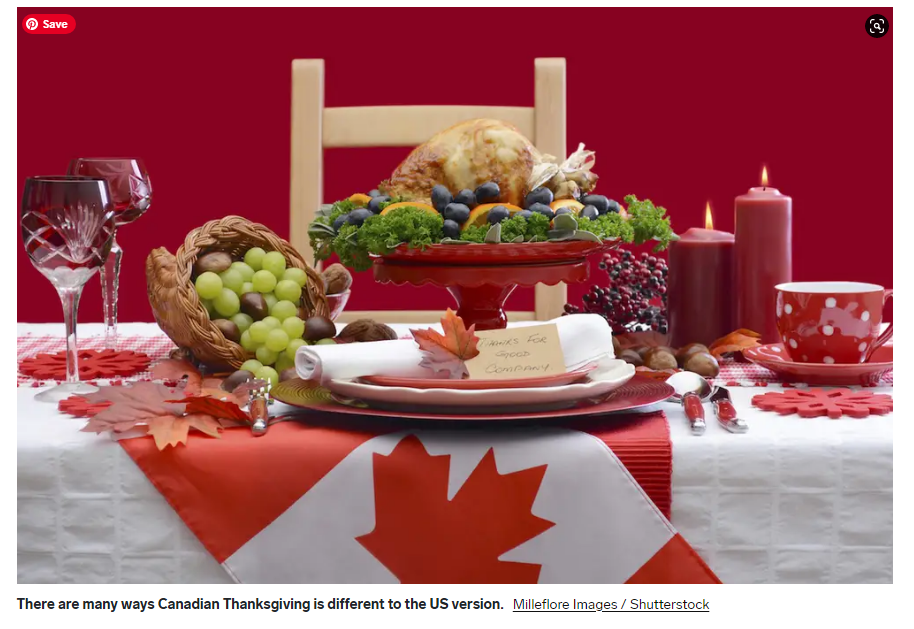
Canadian Thanksgiving, for those of you not from around here, does differ slightly from our neighbours to the south. Not only in our choice of dates, but our holiday involves less football, there’s no big parade, and certainly no black Friday shopping. We get less time off and we tend to focus on the three F’s: food, friends/family and fellowship! Turkey or no turkey.

In fact, our Canadian Thanksgiving is more associated with the harvest season. In 1859, the ministers tried to ask the colonial government to initiate the holiday of Thanksgiving to “thank God for His existence — evident by His bountiful Harvest granted to His people” (a little different from the focus of our American counterparts).
And harvest can be a beautiful time. The weather is great, the colours are fabulous, and the food is plentiful! A perfect excuse for a holiday! Although, I did muse as we drove through the colourful tree-lined roads this weekend: What beauty is in death… the fall colours are really a bunch of tree leaves dying and preparing for a long, hard winter. Sorry, I digress.

Thanksgiving turkeys. Whether you like a stuffed bird or not, the holiday should be about more than the food. Thanks – giving. God reminded His people to celebrate, and celebrate often, in remembrance of all He has done for us! Especially now. In this world so full of despair and darkness, our attitude of gratitude should be all that more evident. I am trying to remember this every time I look at my grocery bill! Thank you, Lord, that I am able to provide for my family. Many are finding it increasingly difficult these days. Is it just me, or are prices going up all around us? But this is a muse for another day. Perhaps, I do need to think about having a few turkeys in my flock of someday-hope-to-have-chickens. I’ll start with the cute little ones.

It’s a Double Edged Sword

Welcome back! April has begun and our calendar is looking busy busy busy! Are you in the throes of preparations for Easter yet? Our schedule has a few things booked before then, but our pastor has been doing a few preparation messages for us these last few weeks… which had me musing…

Sunday, we spoke about Jesus’ arrest and Peter cutting off the ear of the soldier. Which had me wondering, did men in Bible days just indiscriminately carry around swords and swipe at each other randomly whenever the notion took them? Was it a simple dagger? A knight-in-shining-armour sword? What does it symbolize? Why didn’t the soldier fight back and chaos erupt in a full-on Narnian war in the Garden? Yes, my mind goes there.

I do love a good sword fight. The chink and clash of ancient battles. The courageous “charge” – full speed ahead into death and bloodshed for the sake of honour and justice and true love. Okay, maybe it is my romantic side and one too many movies speaking… but have you thought about biblical swords before?

Apparently, the word “sword” appears 424 times in the King James Version of the Bible. The context is somewhat varied… many times in the Old Testament the sword was referenced in war, where enemies were “smitten” in battle. It was a great symbol of power and defence. Think about the angels who wielded their firey swords at the gate of the garden of Eden when man was cast out. A deterrent. A symbol of strength and power.

The sword was also a symbol for anything that inflicted pain on another. The tongue or the actions of a promiscuous woman. Danger, danger! Be warned by such things. Or, let’s think about the double-edged sword. Extra sharp for the deep cuts to the bone… often needed when speaking about God’s judgement. How sharply are we cut down by our own faults and sins. God’s word (the sword of truth) is part of the whole armour of God as we go out to fight the spiritual battles before us.

 “It is sharper than any two-edged sword and cuts as deep as the place where soul and spirit meet, the place where joints and marrow meet. God’s word judges a person’s thoughts and intentions”

(Heb 4:12). 

My studies tell me that a “two-edged sword” marks its own meaning. A double-edged sword is tricky, in that it is sharper and does more damage, potentially, but the damage is not only reflected towards your enemy, as one sharp edge is still pointing towards you as you wield it! (FYI, if you say that something is a double-edged sword, you may be referring to an Arabic expression that basically says if two sides of the same blade are sharp, it cuts both ways.)

So. A lot of info out there about ancient swords. And a lot of symbolic meaning behind such weaponry. And Peter’s little dagger? Yeah, a common tool used by the men of his day. The people Jesus spoke to would have understood about swords and their uses. They would have wielded them honourably in defence. Do we do the same with our sword of Truth? Do we use it as a defence against the rhetoric of today’s world? Do we say: “the Bible tells me blank in answer to your question or statement”. Perhaps Google is our go-to instead. Or Alexa before Jesus. I’m afraid I’m not like Peter coming to Jesus’ rescue when He is questioned.

Photo by Jonathan Kemper on Unsplash

Yes, indeed the sword is a powerful tool. We must learn to use it well in battle, my friends.

Rotting Fruit

Alright, my friends… this post is not for the squeamish, so if you can’t handle the yucky stuff, move on. I have a funny story to share. We had a lovely dinner out this past weekend, and halfway through dessert, I put my hand down on the booth beside me, only to discover something sticky… which I promptly blamed on my son for being messy and dropping his dinner between us. I was wrong. It seemed to be my purse leaking some awkward, yet sweet-smelling substance. Rewind a few days. Heading home from work late and a dear co-worker says, “Here, take this banana home – it’s a little too spotted for my liking”. Yup. Popped it in the purse to empty it later… fast forward to three days of overripening fruit accumulating in the bottom of the handbag. Lightly coating the contents in the thin, fruity film à la rot. Gross. Lesson learned.

Please tell me I’m not alone in this constant battle of trying to keep fresh fruit and veggies crisp and vibrant. Who else fights with avocados and zucchini, willing them to stay around long enough to be eaten? Or “gently reminds” their children not to play with the apples for fear of bruising? Of course, individual consumers are not the only ones who fight the rot. Margaret Barth, author of “Microbiological Spoilage of Fruits and Vegetables,” estimates that of all the product that is grown in the United States, 20% will be lost to spoilage.  In Canada, 45% of produced fruits and vegetables are wasted. And 1.4 million kids don’t have access to healthy choices. A sad reality.

And although efforts are being made to rectify these issues, moving forward is prooving to be difficult. I watched a video recently about “American dumpster divers”. Folks who make it their mission to finding the treasures left behind by stores. Now, second generation iphones are one thing to find… but 50 lbs of overripe cherries? How do we save such a rich resource? One lady in the video explained it simply… time. Her crew of helpers wash, cut and process the perfectly-good-but-needing-quick-attention produce to share with those who need it. A job the supermarkets simply can’t take on, and so the dumpster it is. The divers have a worthy cause, although unconventional. How many of us are willing to make the sacrifice? Visions of one slimy purse banana creep into my head.

And so I muse. What “good intentions” do we have that seem to solve little in this messy world? God created the natural world and humans to co-exsist in perfect harmony. Sin arrived and made it messy. Unfortunately, nothing we can do can restore that perfect connection we had with our Creator. Ephesians 2:8-9 reminds us that it is only through God’s gift of grace are we re-united with Him (perfectly…as He originally intended). None of the “good things” we do can reconnect us. Despite our best efforts, good food still rots. If we work hard and make good choices, we can preserve a larger portion of “fruit” and share the wealth with others who can benefit from our efforts… but ultimately God’s perfect gift of salvation is the only way to an eternity in Heaven.

So next time you pluck out that bruised apple from the fruit basket, or search near the back of the fridge and discover the shrivelled up zuchinni (or dare I say find the left over lunch at the bottom of your purse?) be reminded that our best “fruit” still spoils quickly. The dumpster divers among us can assist in using our resources as best we can. We can help reduce the waste by working together to get the job done before time takes over and everything gets yucky. Ultimately, though, we simply must take the gift God gives us from His pure and perfect garden. And how sweet it is, friends, to taste that perfect offering!

Want to learn more about food waste? Here’s some interesting stats: Food Waste

Want to learn more about accepting God’s free gift? Try here: Perfect Fruit

Want to learn ways to make your food last longer? Here’s one source: Preservation