Match Game

Welcome back, friends! Have you noticed that I have a little theme going on these past few weeks? I didn’t intend for it to happen, but my muses seem to be going “back to basics” as I think about such simple objects… pencils, snowflakes and this week… the simple match stick. I was cleaning out a cupboard recently and found a collection of matchsticks. The box was nowhere to be found and they were scattered all over the bottom of the (one of many) junk drawers in my house. I’m discovering how crazy complex seemingly simple things are. Worth a post or two, I am discovering, as I look up content. Anyway, back to the junk drawer matches. As I gathered them up, I wondered if I needed the original box. Turns out, I may. Apparently, there is a difference between the cheap, safety box o’ matches a la dollar store, and the “strike anywhere” matches via the old movies where the cowboy lights his pipe on the bottom of his cowboy boot.

It comes down to the calculation of complex chemical reactions. And a little friction and fuel. Our safety matchbox holds that strip along the side. The strip contains red phosphorus and teeny bits of powdered glass. The tip of the match stick contains sulphur and a bit of wax (plus the wood of the stick itself). Here’s where the magic happens: match strikes the box, friction via the bits of glass create heat, heat changes the chemical composition of red phosphorus to white phosphorus, white phosphorus is highly flammable and reacts to the oxygen in the air to create heat… the heat is fueled by the oxygen and the wax and sulphur and: poof! FIRE!

Photo by Yaoqi on Unsplash

All of this happens in a fraction of a second. The strike-anywhere matches have all the chemicals contained in the match head… making them a “quick fuse” shall we say? And therefore labelled as “dangerous goods”. They are hard to find easily on the shelves and are accompanied by the appropriate safety guidelines nowadays. Don’t play with matches, kids! My hubby loves a good fire. He’s a big kid when it comes to that mesmerizing flame. The bigger the bonfire the better. Maybe the box is out by our firepit. Currently drowned by the snow. Probably safer there.

I read recently that following Christ is a lot like building a fire. We receive salvation in an instant… like the matchstick igniting. But the matchstick will quickly die out if a fire is not tended and fueled. At first with kindling and tinder. Quick lessons ignite our passion when we first come to faith… we are “on fire”. Then, our journeys slow down and we slow burn for a while… we take time to eat away at the big logs and rejoice that burning embers make for good marshmallows. Yet, without stoking and refuelling, even a giant bonfire with eventually burn itself out. We must continue to fan the flame in our hearts… but the good part is, God is there to help along the way! His word is a constant catalyst for the fire in our hearts. And it never gets used up.

Photo by Claudio Schwarz on Unsplash

I’m finding it hard to keep the kindling hot during zoom calls and online. Despite the lockdowns, my time gets eaten up with other things than personal Bible study. I want to go to concerts, retreats and conferences. I want to meet with other believers who can fuel my fire and ignite the glowing embers of my heart. Still, simple match sticks are complex enough to bring forth a flame on the tiniest of toothpicks. And it only takes a spark to set a whole forest ablaze. Perhaps I need a bit of patience. Or a really good marshmallow skewer and a bit of time to revel in the sweet goodness of burning embers.

A Simple Snowflake

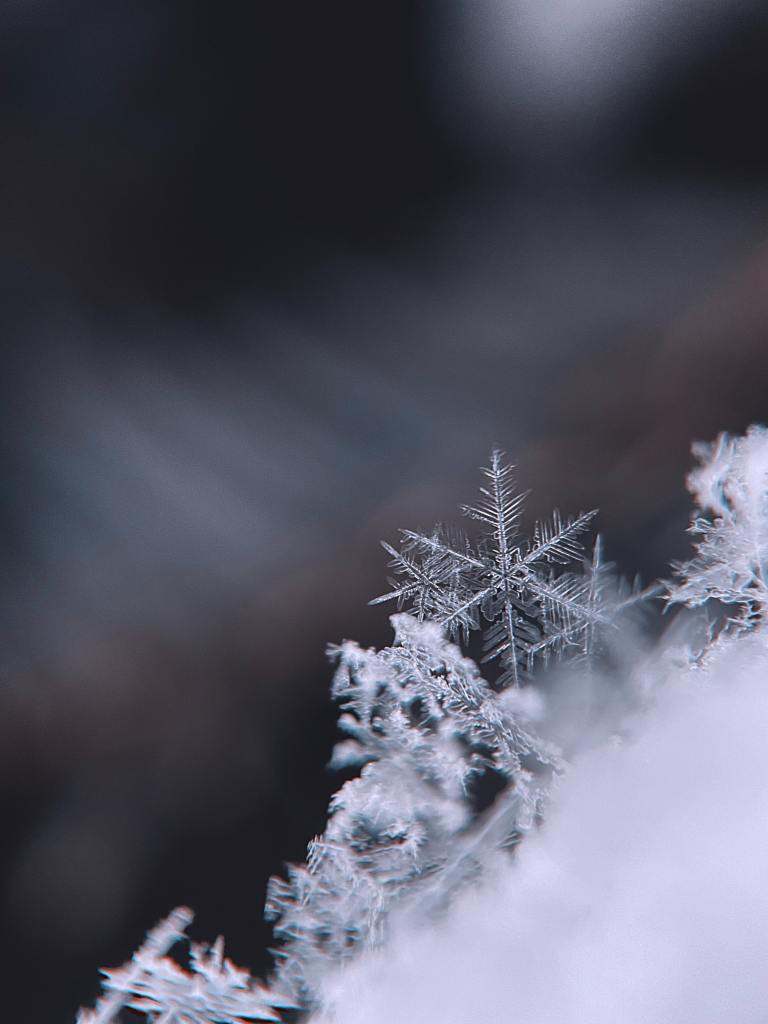
In the heart of another Canadian winter, we trudge through the streets after another snow flurry on our way home after a day of work. My beloved is a good winter driver. I am not a good winter passenger. I white-knuckle it as we brake behind the slow-moving vehicle ahead of us (I am acutely aware of his brake lights seemingly minutes before my driver is and I cannot fathom why he has not braked yet). Our city is still digging out from a huge deluge of snow that was dropped on us a week or so ago. And we are about to add to the snowbanks yet again. We finally talk about something other than Covid. Consequently, my mind wanders to the great mystery of the simple snowflake. The topic of this week’s muse.

Snow is obviously made from snowflakes. Tiny ice crystals that fall from the sky… and pile up so high that we must move mountains in order to carry on with our daily tasks. I cannot even fathom the number of individual snowflakes that one snowbank contains, let alone a city full of snowbanks, or the country …or the world’s snow! Mindboggling. Most people are aware of the fact that snowflakes have distinct shapes. We’ve all seen them on our clothing or windshield. Perhaps you’ve been lucky enough to see them under a microscope. Here’s a pretty one:

Photo via Caltech

Did you know this is also a snowflake?

They say that individual snowflakes can be classified into 80 some snow types? That is amazing! Our Creator is wonderful, isn’t He?! We simply can’t duplicate it. Here is a picture of artificial snow. Basically water droplets froze in the cool air and sprayed on the ski hills for our enjoyment… without the creativity:

You wanna hear another interesting tidbit of snowy inspiration? The ice crystals form when a water droplet freezes on a dust or pollen bit in the sky. Crystallization causes the ice to form into the symmetrical patterns we then classify based on those patterns. Each one is unique because of the twists and turns the dust particle makes on its way down from the atmosphere. Yup, we shovel dirt in the winter… it’s just covered in water. Oh, but how beautiful does that dawn of the new-fallen snow look from our windowsill? All white and pristine, before it gets tarnished by salt and grime and snow tires. The hubby made this remark as we turned the corner onto our street. Sure, I say, just happy to be home alive again from the treacherous trip. It’s beautiful… dirt and water piled high…

So, let’s make a little object lesson from our snow this week. In Psalm 51:7, David prays – “Cleanse me with hyssop, and I will be clean; wash me, and I will be whiter than snow.” Ever feel a little dirty on the inside? David could be our prime example of this object lesson. Yet, we are no less dirty. Our “specks of dust” twist and transform our ways and can pile up like the heaps of snow we shovel off the driveway. It has nowhere else to go. But, like that snowflake, God takes all that dirt… and covers it up to make something beautiful!

“Come now, let us reason together,” says the LORD. “Though your sins are like scarlet, they shall be as white as snow; though they are red as crimson, they shall be like wool.”  Isaiah 1:18 Our pure and just God cannot be tarnished by our unholiness, but when covered through Jesus’ sacrifice we shall be as white as snow! Our dust has been covered and only the beauty remains. What a promise!

Oh, friends, these days of Covid and snow and winter and isolation have many of us tired and fed up. We are heavy-ladened with the burdens of just trudging through… literally! Alas, our hope is full and it covers the dirt completely! We need cleansing and some good old fashion scrubbing to revive us so that we will be as white as the snow. I’m looking forward to finding that little bit of magic in all this. The silver lining … or should I say the white lightning in the simplicity of some dirt and a water droplet.

Photo by Aaron Burden on Unsplash

Emotional Wreck

Have you ever been so mad you could just spit nails? I was there this week. Bottled up anger fueling a stubborn streak that is still trickling through my veins. If nothing else this introvert will always win a battle of the cold shoulder. Trust me. On the other side of the coin, I just got off the phone with a friend who was engulfed in a mix of grief, frustration and sadness. Tears flowed and she simply didn’t know how to function. Still another friend expressed her feelings about the current state of affairs in Afghanistan’s Taliban take over with shock. How can human beings be so fearful that they would risk hanging off the landing gear of a moving plane?! “Unbelievable” she writes. Last week we witnessed a blushing bride and groom goo goo over each other in the innocence of newlywed bliss. (Yes, goo goo is my official word for that). We humans were made with emotions as part of the package. They are literal parts of our physical make up. I don’t know of anyone who hasn’t been overcome by some sort of emotion… heaven knows our first cries are emotional outbursts! Which has led to my muse this week: How do Christians deal with emotions?

I read a thought-provoking article on the subject, which made some interesting points and comparisons. Obviously, our emotions — the feelings that drive our passions, our interests, and our pursuits, are stemmed from some sort of emotional response to “things” in our environment. What we like and dislike dictates how we live. Yet, many of us view emotions as problematic. You can’t trust your heart. Emotions are irrational and unreliable. You need more faith. Just trust in God. All will work together for good… Heard any of these before? But our emotional baggage is not simply feelings floating around in our heart… they are influenced by our culture, our experiences, and the time and space we live in. Our culture in 2021 is, I believe, so much more open to expression, interpretation, and mental awareness of our “emotional state” then any other time in history. The question becomes… is this good or bad? Do emotions threaten us in the church? If we have the “joy of the Lord” in our hearts should we shy away from anger, sadness, guilt or depression? Is a feeling of pride good or evil?

Obviously the Bible gives us many examples of “emotional wrecks”… characters who acted (seemingly) irrationally to some emotional trigger. Heart responses to outside stimuli. Humans acting the way humans do. Joseph, David, Sarah, the prodigal son, even Jesus and the disciples. So, what should our response be? And here I will credit the aforementioned article for enlightening my answer… because that trickle of anger is slightly tarnishing my views at the moment. Number one: the Bible makes it clear that we are broken people living in a fallen world. We are not perfect. This world is not perfect. We will not be perfect this side of Heaven. It is a loosing battle to pluck out a set of circumstances and rely on that circumstance alone. Our friends will fail. Our tradition, culture or family background does not make “all things right”. Even our church, our pastor, or the Bible teaching we hear is not foolproof. We can misinterpret and twist things. One just has to look at church history to see the results of that path. Our heart responses are not always correct, but they are a part of how God made us, so we must consider them as valid parts of our existence.

Photo by Tabitha Turner (Unsplash)

As Christians, what we can be certain of, is that our faith will profoundly impact our hearts. The end story of the gospel is what drives us. The hope we have is what allows us to see a different reality, if you will. One that is not always obvious, but “imagined”, or allowed to be seen, eventually. Jesus’ emotional outbursts were examples of always having God’s gospel goal in His vision. God’s character must give us an answer to our emotion. Because He is merciful and loving, we must be comforted in our grief. He is slow to anger, but still just and holy. We must therefore be diligent in not sinning in our guilt or in our anger. We are not the final judge, He is. So. Are we perfect? No. Is God? Yes. Seems like a perfectly logical answer to all our problems, right? Yup, cheers to you, my fellow emotional wreck. Here’s to one more step on the journey.