
10 000 Fireflies

Have you ever seen a firefly? Unfortunately, the light pollution in our city makes the nostalgic experience rare and far between most summer nights. Recently, however, I was out walking the dog in a back field out in the country, where the city lights were significantly dimmed enough for me to catch a glimpse of a few lightening bugs calling to each other. I wouldn’t have paid too much attention, normally, but the quiet of the evening and the fact that our chocolate lab is almost invisible in the dark, made me consciously scan the bush edge for unsuspecting creatures or beady eyes staring back at me from the shadows. I smiled to myself as I watched for awhile and then proceeded to ask the dog if he noticed them too? Yes, out loud. Don’t judge me as I talk to the dog, okay?

Photo by: Cathy Kiefer

Being the good scientist that I am, I thought the little beetles might be interesting to learn about… not everyday you see glowing butts as a way to catch the love of your life’s attention, is it? There are about 2 000 species of fireflies — and not all can use bioluminescence. The “glow” is produced to lure a mate and can be green, orange or yellow coloured. It is created by the combination of oxygen, calcium, ATP and an enzyme called luciferase. Luciferase is derived from the (get this!) Latin word for lucifer…meaning “light bearer” and has been a very important chemical in science for detecting all sorts of things in cells and living creatures. It is apparently very efficient — nearly 100% of the energy produced in the chemical reaction produces light.

Yet not all fireflies can boast such (pardon the pun) glowing reviews…some are deceivers. Some use their light to attract prey. The unsuspecting love seeker gets all caught up in the show and gets eaten for its efforts. Some fireflies will actually “steal” other flies from spider’s webs! Packaged lunch to go! Wanna hear the cool word for that behaviour? “Kleptoparasitism.” Researchers still don’t know how the burglars get on and off the webs without getting caught themselves….

Isn’t science fascinating?! But more than that, I think God uses these real life examples to teach us more than cool vocabulary words. So many life lessons are observed by watching the world around us. Is it co-incidence that the most efficient light is named after Lucifer? How attractive he is … and how easily he ensnares us into following him! The little blips of temptation can easily go unnoticed until they catch our eye and distract us into mesmerizing patterns, drawing us deeper and deeper into the darkness — only to devour us later. You need a lot of “darkness” to see the tiny blips of fireflies … surrounding yourself with light will drown them out. In fact, our light pollution is creating a decline in the numbers of fireflies … they can’t reproduce if they can’t find mates. Do you see the lesson here?

The band Owl City has a bubbly little tune called 10 000 Fireflies. (Find it here). It draws us to the nostalgic side of watching fireflies and believing in the “magic” of our childhood dreams. Obviously, life isn’t as easy as our childhood wishes… and frequently we spend sleepless nights worrying about things that are often out of our control. May you be encouraged this week that there is someone who does care about you and your dreams. He’s not “magical” or flashy… He’s simply the God who loves you. And me. The One who created 10 000 fireflies… and the God who made me notice one, so I can tell you the story of how it made me smile on a summer’s evening (and talk to the dog out loud.)

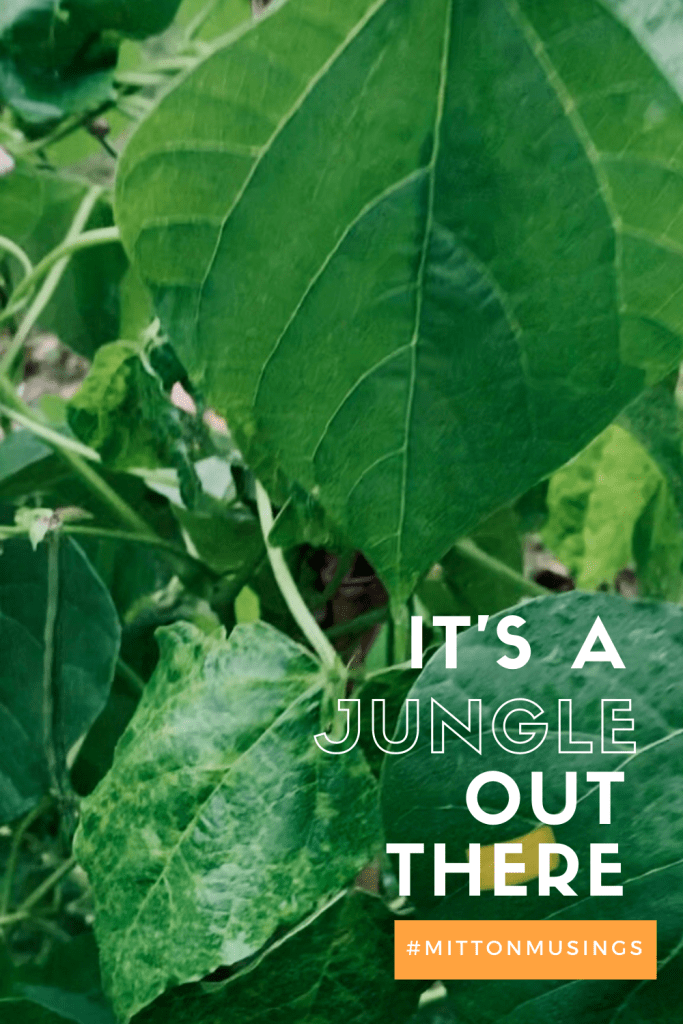
It’s a Jungle Out There!

I thought this week’s blog post was going to be about sweet peas. Pretty little flowers. Popeye and Olive Oyl’s cute little cartoon baby. The fragrant little plant that makes a great veggie. We have some peas… and I dunno if they are sweet peas or not… but I have them growing in our urban garden. I like them… they grow well and we’ve had some great harvests. I was going to tell you about how I went out to tame them with some clips and string and bamboo skewers and how proud I was of them. But that is not how this muse went.

I went out to discover the garden has become a virtual jungle. The great rains we’ve had in the last few days have turned the place into a labyrinth of green! Okay, I admit it. Perhaps I am not as diligent at weeding as I should be… but these are not just weeds… the actual veggies have exploded! Currently, we have some zucchini plants and some cucumbers which are holding their own and doing their “normal” spread. They are behaving. The peas and beans are now quite ladened down with heavy vines and I am not sure how to separate them. They have no more space to expand to, so they are growing into each other. Even my strawberries are shooting out tendrils!

Yet, my biggest “expander” (and I say this with a little excitement) is our pumpkin vine! The youngest wanted to try it this year, so we simply threw a few seeds in a space near the end of the garden before the sunflower patch. Well… as they say, if you plant it … it just might grow! Our pumpkin has now weaved it’s way through the sunflowers, down the fence and reaching up along the side of the lawn into Neverland! The vines have taken over!

So, I did a little research. Apparently there are two different kinds of “vine” expansions: twining or hold fasts. Vines that use tendrils wrap around their supports using thin, leafless stems… those curly cues you see on grape vines, for example. Other climbers use “sticky” pads or aerial roots to adhere to almost any smooth surface. Like ivy growing on ancient castles. So how do they know to grow up and wrap around something? They don’t. Vines do something called “thigmotropism”. Those little stems grow until they mechanically “hit” something… by wind or whatever… and end up twisting around the structure to hold on. This is why you can “train” vines to climb a trellis. (Obviously my jungle proves we have not done this!) There are some very cool looking slowmo videos of “thigmotropism” out there. Look it up!

Not my peas…but Sweet Pea (lathyrus Odoratus) is a photograph by Maxine Adcock/science Photo Library which was uploaded on February 24th, 2021.

So… what’s our take away from my jungle adventure? You got it… John 15:5 comes to mind. “I am the vine, and you are the branches…” Growth occurs when we are attached to a stable structure. Heaven knows we certainly need something stable in this ever changing world!! Especially when we are facing struggles. Or the unknown. Or simply putting the “feelers” out on a big decision we need to make. Wanna know another cool thing about thigmotropism? The bigger the stimulus the plant receives, the faster the tendril growth and the stronger the coils become! Sound familiar? Yup, often our biggest valleys in life produce the greatest and strongest amount of spiritual growth!

Well… turns out my fragrant and pretty sweet peas were not as encouraging this week as my jungle of pumpkin vines! I guess that is just the way it is sometimes in life. Here’s to “thigmotropism” and to you, my growing friend! Hold fast this week!

Patience as a Virtue

We had a little lesson in patience this week. Okay, we’ve been having a big lesson in patience this whole year, haven’t we? I don’t know about you, but I think I am finally getting sick of this lockdown — even as an introvert. We’ve been waiting. We’ve been waiting for haircuts and restaurant meals and movie theatres. We’ve been waiting in grocery lineups and online check out queues for the free shipping days. We’ve been waiting to get back to family gatherings and celebrations and hugging. Yes, even me. I’ve been waiting, too.

We had a smaller lesson in patience this week — a simple one that no one really noticed except me. Which was the inspiration for this week’s muse. Let me explain. One of our favourite “snacks” is something called Butterscotch Confetti. It’s easy to make and yummy. I was going to post the recipe, but remembered I already did! So… check that out here. Anyway… the youngest decided to make up a batch of the decadent “squares” (Did you know that Canadians call them “squares” and American’s call them “bars”… total side note but I am just free writing… so, hey what the heck…go on a rabbit trail… Wonder what other countries call such desserts… oh, a muse for anther time….)

Where was I? Oh yeah. Butterscotch squares. So, when you make these things, you melt all kinds of yummy goodness in a pot and then you have to “wait until you can hold your hand on the bottom of the pot before adding your coloured marshmallows”. Herein lies the lesson in patience. Wait. It’s a delicate balance, because if you don’t wait, your marshmallows melt and you get a sticky mess… I’ve seen it done. But if you wait too long, then your other ingredients start to harden into the fudge-like dessert they are supposed to be… without your marshmallows. You get it. Now, I have a fairly high heat bearing feel, so I tend to be impatient and throw in the coloured package of squishes fairly early. So far they have not melted away yet, though. And so I marveled as the pot sat on the stove as my daughter “waited” for it to cool. I usually have something to fill in my time so never have I “waited” for this task to occur… at least not that I have noticed before. Hence, this week’s muse.

Patience. The old time phrase “patience is a virtue” was never actually quoted as such in the Bible. Patience is not a “virtue”. Or is it?

“Hot tempers cause arguments, but patience brings peace.” Prov. 15:18. “Love is patient. Love is kind” 1 Corinthians 4:13, “Rejoice in hope, be patient in tribulation, be constant in prayer.” Rom 12:12. “Be completely humble and gentle; be patient, bearing with one another in love.” Eph. 4:2. And that is only a sampling of the verses that talk about this all important fruit of the spirit. Obviously, patience is something we need to work on in our lives. Let’s be honest, though, it’s a difficult one. To the mom who has the two year old who wants to put on her own shoes when you are already late leaving for your appointment. To the parent who has the wayward teenager who must learn the hard way. To the senior who has to care for the body who doesn’t work the way it used to. Sometimes there is no answer and we just have to go through it. Then patience is not in the waiting …but in the day to day, one foot in front of the other kind of patience which is linked arm and arm with endurance.

Learning patience is not simply an emotional response to a trying situation, either. It involves your belief system, your physical ability to self control and self regulate as well as your thoughts about gratitude. Does your impatience lead to anger, or can you hold your breath, count to 10 and take control of the time? Are you grateful for where you are now or are you waiting for the next best thing…now. Do you dump those marshmallows too early?? It takes practice.

I discovered that the word “virtue” is used to describe a trait or quality that is deemed to be morally good. In other words, it is a behavior that shows high moral standards: doing what is right and avoiding what is wrong. Is patience worthy of “virtue” then? Perhaps. It certainly is a Biblical truth that should be practiced and “worked on”. Especially if you want perfectly decadent butterscotch confetti.