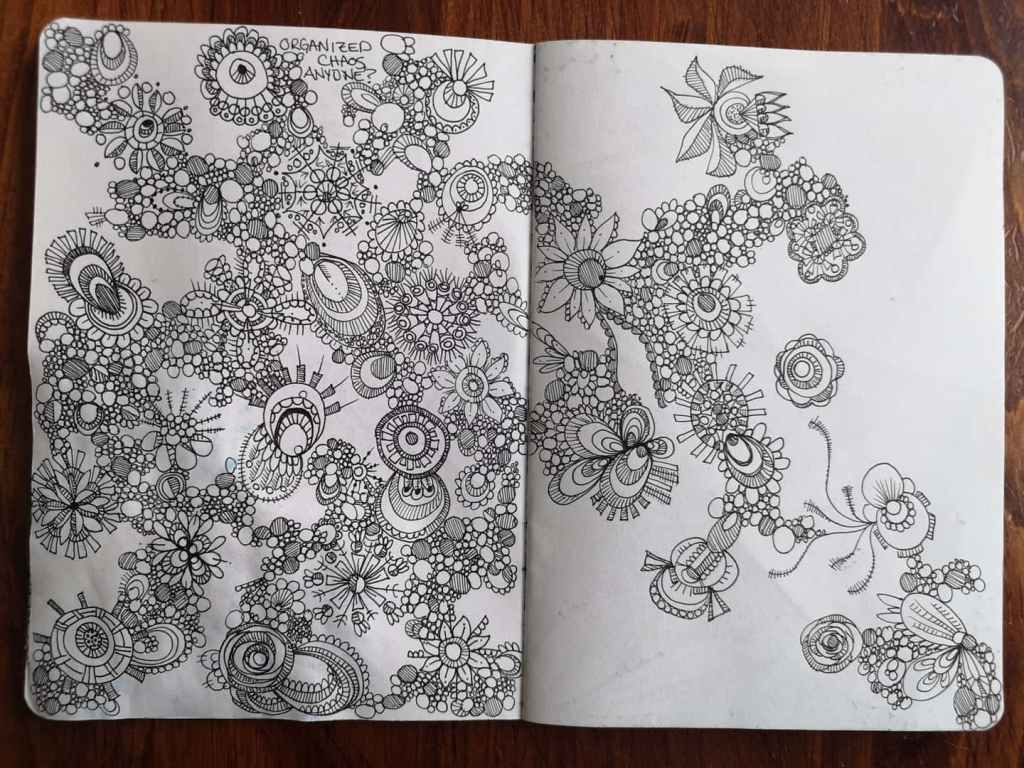
Patterns

I was sitting on the couch a few days ago working on a crochet project I have going for Christmas. As I was flicking my fingers and yarn, I got thinking about patterns. Patterns seem to be everywhere! When you learn to crochet or knit or paint or even write, you start with a pattern. You learn basic stitches or strokes and then adapt those into complex arrangements of the pattern. Sometimes the patterns repeat over and over again. Those complex arrangements become the intricate design that, eventually, becomes your masterpiece! If you look closely enough at a masterpiece, you will see the tiny repetitions within. I love a good pattern. It makes everything so neat and tidy. I like even numbers and ducks in a row. I’ve mused about it before (check it out here).

Thanks for the doodle, Ruth!

Have you seen it? Repeating patterns in buildings, flowers, clothing… almost anything both man-made and natural contain these “repeats”. I think God liked patterns too. We’ve seen how He gives us colours, symbols, numbers and the like to point us in the direction to go. (check out our “colouring party series” of posts here) Some small details paint a bigger picture of something. Some small details make up a larger masterpiece. Let’s go back to painting for a minute. Simple strokes of the paintbrush and basic colours are usually the start of a painting. Then, as more blending of strokes and colours happens, a more complex picture shows up… a tree of bushy branches, a rocky creek of shadows and depth, a sunset of layers of colours on the horizon. Fabulous, isn’t it? Are you seeing it?

Now. Let’s imagine you are writing a letter to someone you care about, but you want the letter to contain notes from all your friends to that same someone special. Everyone will have their own unique take on the message, but the “theme” of the note will be the same… the pattern’s building blocks with “the basics” will be intertwined throughout the note. Do you see where I am going here, my friends? Of course! The Bible is God’s love note to us! Yes, different writers have had their part to play in the history lesson, but God’s love letter is full of patterns!

Photo by George Becker on Pexels.com

I learned a unique way of Bible study some time ago that showed me just how to see these patterns in the passage I was studying. Take a handful of pencil crayons and as you read, start circling or underlining phrases or words that mark the building blocks of the pattern. For example, green for places, black for a time, circle people, highlight promises or commands or warnings. Then, as you flip through your pages, the patterns begin to emerge. Ever wonder why the authors repeat themselves? Are they making an important statement? One, we perhaps need to pay attention to? Trust me, you’ll begin to see the masterpiece emerge from the basic stitches repeating over and over again!

I saw the Bible described this way:

The Bible is a compilation of 66 books written over 1,600 years by 40 authors, all inspired by the Holy Spirit and beautifully telling the Big Story of God.

This Big Story is sometimes called the metanarrative of Scripture. It’s the story of how God works in the world through creation, fall, redemption, and restoration. (onethingalone.com) Each little story falls into place in the Big Story.

That “metanarrative” is the masterpiece encompassing all the little brush strokes and basic stitches contributed by 40 authors in 66 books. Cool, eh?

So, maybe next time you sit down to study you’ll give this colourful pattern hunting a try. Supplement it with journal keeping, or doodling or whatever you like that draws your attention to the Big Story of God’s love for you! You’ll be glad you did.

Then, you’ll begin to see the patterns everywhere… trust me.

Reduce Reuse Refurbish and Repent

Don’t you love the way your computer seems to “know” what you’ve been researching? You search up one little thing and you are bombarded with ads for that thing for the next two weeks. Or you happen to “like” a video or post, and your inbox is over run with similar posts and opposing views from like people…even those folks you haven’t heard from in awhile. Isn’t technology wonderful? Algorythms and secret formulas that lock you in to keep you engaged… Hopefully, mittonmusings.com is on your radar and we get the repeat customers!

“Flip”

Blatant plugs aside, my feeds have been filled with “furniture flips” lately. Or thrift finds that people refurbish and renew. Then these folks go on to make a financially significant side hustle… making thousands of dollars in seemingly quick and easy revenue. I don’t know if “flipping” is as easy as they make it out to be on television … but there it is, tempting me to try. I love to thrift, but I don’t have that knack that some people seem to have. They easily see the beauty and potential in long forgotten objects. I want to, though. I love to see things made “anew”. Plus, I don’t like to see things simply tossed in the trash because they are no longer “fashionable”. Hence the hoard of craft supplies in my basement. I’ll use them someday. I will. And they will be beautiful….

I got thinking aobut that little prefix: “re”. Reuse, recycle, refurbish, renew… and repent. According to dictionary.com, that little prefix is defined as:

a prefix, occurring originally in loanwords from Latin, used with the meaning “again” or “again and again” to indicate repetition, or with the meaning “back” or “backward” to indicate withdrawal or backward motion:regenerate; refurbish; retype; retrace; revert.

Which makes sense when we are talking about redo or refurbish. We can even “recycle” lots of things over and over again. But does “repent” have the same prefix? Maybe not. Still, for the sake of argument, let’s decide for the moment that it does. Or maybe it revolves around the second half of the definition and one must move back before moving forward. That sounds a lot like how I repent. Or maybe how we should repent. We do something we shouldn’t and for a second, we need to step back and take ownership. They say that we have to “name it and claim it” in order to change our behaviours for good. In order to move on with clean slates.

It’s like that piece of furniture or house we want to renovate. Sometimes you have to strip off the old paint and pull off the wallpaper to really get to what’s underneath. Only then can you start afresh and move forward. Do you see it? I used to have to remind my kids about this. “Saying Sorry” means very little unless you actually change your behaviour. True, sometimes the “saying sorry” is the first step in stripping off the old, but true change only occurs when you keep going forward.

Then there is the “again and again” factor. Ever fall into the trap of “here you go, God – I’m done with this or that”, but then we take it back again and recoil into our same worries, sins and destructive behaviours. It’s tough. I graciously acknowledge that this is the hardest part of our faith journeys. The one-foot-in-front-of-the-other, day to day journey that leads us heavenward. But….

But. The reason I love “flipping” videos so much is the before and after. The “new” from the old is sometimes so different, the transformation is breath taking. And so it is with us, my friends. As we become new creatures in Christ, the old is (sometimes slowly) stripped away, revealing the true beauty that we were designed and destined to become. Here’s to one more step forward… and a little “re” now and then.

You are “Here”

Welcome back to another week of the weird way I think. Can I start by saying I appreciate you reading my quirky little posts? It helps to know that someone, somewhere, thought about the same things I think about and took time to comment. It gets noted in my heart. Today is a rainy, chilly day in the depths of October. The weekend, though, was beautiful — and we reveled in the warmth of a delightful fall Saturday and Sunday! Guess life is about balances, eh? We met friends (yeah for meeting friends again!!) and found a new walking trail to explore with the dog. Which is where I start my muse for this week. Have you ever been to a new location and about to start out on a journey and you consult the official map board posted at the entrance? They have them in the mall, provincial parks, large buildings, amusement parks… those signs that say this trail is 45 minutes long and loops around the pond, or your favourite shoe store is next to the donut shop on floor 2, or the five public washrooms are located here, here, here and here and here, but there is only one that is family friendly, and it’s back at the entrance….

One thing that all those map signs have in common is the “you are HERE” spot. That red dot or arrow indicating the location you are standing at right now. The central location you currently understand — and the spot in which you navigate the rest of your journey from. That little dot is your orientation. It’s your point of beginning. It’s also sometimes your final destination! The goal you want to get back to after the day of exploring. And so I began to muse… where is “here” in life? Where are you “at” right now, compared to the big map board of your journey? Big questions. Perhaps big answers.

My searching didn’t help much in answering the big questions of life. I did find a little tidbit of random information, though, about the “@” symbol…. commonly called “at” in modern day computer language… originally penned by medieval monks, the symbol became standard in commerce in the 1800’s to mean “at the rate of”. It wasn’t until 1971 that a computer scientist named Ray Tomlinson needed a way to connect his computer programmers to one another…and “randomly” chose the obscure symbol on his typewriter. The rest is email history, as they say! Bloggers will tell you it’s where they are “@”. Okay. Moving on.

Let’s go back to where we are at. The “we are here” dot. Are you happy where you are? I think about this a lot. I like to set goals, but I find I rarely meet them. Am I content? There’s a big theological discussion waiting to happen.

“I am not saying this because I am in need, for I have learned to be content whatever the circumstances.”

Philippians 4:11

What did Paul mean when he says that he has learned to be content? Was he financially secure with investments to keep him happy well into retirement? Or was he simply sharing thanks for the gifts the Philippians sent him? Does it mean we can’t ask for more? Should we be striving for more? The verses before remind us to “present your requests to God” and “think on things that are noble and true”. I don’t know. I am HERE. On this dot. Yes, I can be content here, with God’s help and blessing. Perhaps this is where He wants me to be for now, in order to serve a greater purpose in His plan that I don’t know about. I’ve been thinking about Hannah — who wanted a son so bad it ached. Was it wrong for her to pour her heart out to God in prayer? Was it her faith that God would answer her prayers that led to Samuel’s birth? Should she have been content to be greatly loved by her husband and not need more? Her husband thought so.

As usual, I don’t have all the answers to such questions. I struggle with them too. Yet, I think it is important to take note of the “you are here” dot in life. To look at the big board and figure out if you can go around the pond and still make it back to the “you are here” dot in time for lunch. Or should you wait here and not go to the donut store on floor 2? Are you looking at the map, my friend? Are you staring at the possibilities with excitement? Or are you learning to be content “@” home base? Where people know where to reach you. It’s all part of the journey, and worth the muse.